Supporting Statement A_Revised (1)
Supporting Statement A_Revised (1).docx
Juvenile Facility Census Program (JFCP)
OMB: 1121-0381
Juvenile Facility Census Program
OMB Control Number 1121-0381
Department of Justice
National Institute of Justice
Office of Juvenile Justice and Delinquency Prevention
OMB Information Collection Request
Paperwork Reduction Act Submission
Juvenile Facility Census Program
OMB Control Number 1121-0381
Part A. Justification
Overview
The National Institute of Justice (NIJ), in partnership with the Office of Juvenile Justice and Delinquency Prevention, requests approval to conduct the Juvenile Facility Census Program (JFCP).1 The JFCP will consolidate two previously, separately cleared data collections (The Census of Juveniles in Residential Placement [CJRP, OMB# 1121-0218] and the Juvenile Residential Facility Census [JRFC, OMB# 1121-0219]) into a single data collection.
The JFCP collects information from all secure and nonsecure residential placement facilities that house persons younger than age 21 who are being held as a result of some contact with the juvenile justice system for a law violation. This encompasses both status offenses and delinquency offenses and includes youth who are either temporarily detained by the court or committed after adjudication for an offense.
The JFCP consolidates the content of the CJRP and JRFC into a single, unified program. It collects general information on facility characteristics and the number of youth housed, and includes two rotating content modules that are administered separately during a two-year collection cycle: the Youth Population module and the Facility Operations module.
The Youth Population module collects detailed information on individual youth housed in facilities, including demographic details, placement characteristics, and length of stay. The Facility Operations module collects information on resident services, facility features, and operations.
Necessity of Information Collection
The U.S. Department of Justice (the Department) has long taken an interest in juveniles held in custody, the operation of the facilities in which they are located, and the services available to them while in custody. In 1971, the Department began a census of juveniles in custody known as the Children in Custody (CIC) Census (more formally: The Census of Public and Private Juvenile Detention, Correctional, and Shelter Facilities). In 1974, OJJDP took over implementation of that census upon authorization of the Juvenile Justice and Delinquency Prevention Act (the JJDP Act). In 1993, OJJDP began a broad, long-term examination and revision of its data collection efforts covering juveniles in custody. This effort included extensive consultation with experts interested in the data produced, discussions with respondents, and extensive testing of questions and methods. In 1997, OJJDP conducted the first CJRP replacing the population component of the former the CIC data collection. Concurrently, development of the JRFC commenced in 1996 to collect information on the facility operations and service provision. The testing phase was completed in 1999 when the final report on the October 1998 field test was provided to OJJDP. The JRFC was subsequently fielded in 2000 and every other year through 2022.
In fiscal year 2019, the Department transferred OJJDP’s research, evaluation, and statistical functions and activities to the NIJ, including the management of juvenile-related data collections. As such, NIJ is working in collaboration with OJJDP and its data collection agent, the U.S. Census Bureau (Census), to elevate and advance this work for the juvenile justice community.
NIJ in cooperation with the Research Triangle Institute (RTI) and Census conducted a broad review and redesign of the CJRP and JRFC which included extensive consultation with experts; discussions with respondents; cognitive testing in 2020, 2023, and 2024; and pilot testing in 2021 to determine the feasibility of collecting new data items and identify changes to existing data items on the previously separate CJRP and JRFC survey instruments. The content changes detailed below were based on the findings from all rounds of testing.
In 2025, OJJDP consolidated the CJRP and JRFC into one data collection, the Juvenile Facility Census Program (JFCP), to attain cost savings and reduce respondent burden.
The JFCP plans to move towards eliminating collection by paper form when possible. Throughout this submission, the word “form” refers to the digital version of the form accessed by respondents using our online collection instrument rather than a paper form. A pdf copy of the paper form is available on the collection site to respondents to print if desired. Below is a short description of the forms utilized for data collection.
Form CJ-14 – Juvenile Facility Census Program – Youth Population Module: The Youth Population module asks about characteristics of the facility that are critical for frame maintenance and annual reporting, such as facility ownership/operatorship, facility type, and population. It also requests two rosters: one of all youth in the facility on a specified reference date, which includes data on sex, date of birth, race, placement authority, most serious offense, location of offense, court adjudication status, and date of admission; and one of all youth released during the month prior to the reference date, which includes sex, date of birth, race, most serious offense, date of admission, and date of release.
Form CJ-15 – Juvenile Facility Census Program – Facility Operations Module: The Facility Operations module asks about characteristics of the facility that are critical for frame maintenance and annual reporting, such as facility ownership/operatorship, facility type, and population, and collects information on a rotating basis about facility operations, including staff trainings required and mental health, educational, substance use, and medical services available to residents.
Copies of the JFCP module forms are available in Attachment A.
NIJ is authorized to conduct this data collection under the Omnibus Crime Control and Safe Streets Act of 1968. Copies of the relevant sections of the NIJ authorizing language are included in Attachment B of this OMB package.
OJJDP is authorized to conduct this data collection under the JJDP Act of 1974, as amended. The JJDP Act was reauthorized in December 2018 through the Juvenile Justice Reform Act of 2018 (Public Law No. 115-385). For purposes of this PRA request, the relevant part of the reauthorization language reads as follows:
(b) Statistical Analyses. The Administrator shall
(1) plan and identify the purposes and goals of all agreements carried out with funds provided under this subsection; and
(2) undertake statistical work in juvenile justice matters, for the purpose of providing for the collection, analysis, and dissemination of statistical data and information relating to juvenile delinquency and serious crimes committed by juveniles, to the juvenile justice system, to juvenile violence, and to other purposes consistent with the purposes of this subchapter and subchapter I.
34 U.S.C. 11161
The JJDP Act also includes a requirement that OJJDP’s Administrator submit to Congress and the President an annual report on juveniles in custody. The specific language that describes this report is as follows:
(1) A detailed summary and analysis of the most recent data available regarding the number of juveniles taken into custody, the rate at which juveniles are taken into custody, and the trends demonstrated by the data required by subparagraphs (A), (B), and (C). Such summary and analysis shall set out the information required by subparagraphs (A), (B), (C), and (D) separately for juvenile nonoffenders, juvenile status offenders, and other juvenile offenders. Such summary and analysis shall separately address with respect to each category of juveniles specified in the preceding sentence—
(A) the types of offenses with which the juveniles are charged;
(B) the race, gender, and ethnicity, as such term is defined by the Bureau of the Census, of the juveniles;
(C) the ages of the juveniles;
(D) the types of facilities used to hold the juveniles (including juveniles treated as adults for purposes of prosecution) in custody, including secure detention facilities, secure correctional facilities, jails, and lockups;
(E) the number of juveniles who died while in custody and the circumstances under which they died;
(F) the educational status of juveniles, including information relating to learning and other disabilities, failing performance, grade retention, and dropping out of school;
(G) a summary of data from 1 month of the applicable fiscal year of the use of restraints and isolation upon juveniles held in the custody of secure detention and correctional facilities operated by a State or unit of local government;
(H) the number of status offense cases petitioned to court, number of status offenders held in secure detention, the findings used to justify the use of secure detention, and the average period of time a status offender was held in secure detention;
(I) the number of juveniles released from custody and the type of living arrangement to which they are released;
(J) the number of juveniles whose offense originated on school grounds, during school-sponsored off-campus activities, or due to a referral by a school official, as collected and reported by the Department of Education or similar State educational agency; and
(K) the number of juveniles in the custody of secure detention and correctional facilities operated by a State or unit of local or tribal government who report being pregnant.
34 U.S.C. 11117
Copies of the relevant sections of the JJDP Act reauthorization are included in Attachment C of this PRA package.
Redesign Study of OJJDP Juveniles in Corrections Data Collections
In 2022, RTI International (RTI) released a report evaluating the data collection instruments and methodologies used in the formerly separate CJRP and JRFC surveys. The assessment, conducted in collaboration with NIJ and OJJDP, identified areas for improvement to enhance the quality of the data collections (OMB Control Number 1121-0360). Issued under a cooperative agreement, managed by NIJ, the study engaged with external experts, NIJ, and OJJDP to assess the utility and relevance of the items and evaluate gaps in the previous instruments to determine if they adequately captured recent changes in facility operations and service delivery; current federal legislative requirements (including the 2018 reauthorization of the JJDP Act); and other contemporary juvenile justice issues. RTI then conducted a pilot study to assess and recommend changes to the two instruments. The executive summary of this report is available in Attachment D and the full report is publicly available through the following link: https://www.ojp.gov/pdffiles1/nij/grants/304796.pdf.
In fiscal year 2024, Census, managed by NIJ, cognitively tested additional changes to the two instruments building on the recommendations from the RTI report (OMB Control Number 1121-0360). Cognitive testing included two rounds of moderated interviews with respondents and one unmoderated round of cognitive testing to garner feedback on items for possible inclusion on the two surveys. The final report of the cognitive testing results and recommendations are available in Attachment E.
Content Changes
The Juvenile Facility Census Program (JFCP) consolidates the former Census of Juveniles in Residential Placement (CJRP) and Juvenile Residential Facility Census (JRFC) into a single, unified data collection. The program features two rotating content modules—the Youth Population module and the Facility Operations module—administered separately during a two-year collection cycle. This consolidation involved removing duplicative items while maintaining essential data elements.
The Youth Population module collects detailed information on individual youth housed in facilities, including demographic characteristics, placement details, and date of admission. The length of stay section is presented in a roster format that mirrors Section 2 of the Youth Population module. This module was initially launched under the CJRP name with the 2025 collection, which included the new length of stay section.
The Facility Operations module collects information on juvenile residential facility operations, services, and training requirements. Several new questions were developed through research, cognitive testing, and expert input, informed by findings from the RTI International report cited in an earlier section.
Beginning with the current cycle, JFCP uses an online-based response system. While most respondents indicated comfort with electronic submission during cognitive testing, some requested access to a hard copy. To accommodate this, a fillable PDF of the instrument is available for download and printing from the survey website. Respondents are expected to submit data electronically. Invitation letters and reminder postcards continue to be mailed.
Additional content revisions were made to improve usability and reduce redundancy. Several questions were removed, and demographic items were updated to reflect revised federal standards. A new exit point, based on facility characteristics, was introduced earlier in the instrument to allow out-of-scope facilities to discontinue the survey. This change helps limit unnecessary burden and supports maintenance of an accurate facility frame.
A summary of the content changes for the JFCP are available in Attachment F.
Needs and Uses
The data collected from the JFCP will continue to inform the Nation’s understanding of youth placed out of home due to contact with the juvenile justice system and the facilities that hold them. These facilities include shelter facilities, detention centers, alternative placements, or more traditional secure correctional facilities. The JFCP consolidates two long-standing data collections. No other data collection at the national or state-level collects the quality or volume of information gathered by this census. Specifically, the JFCP is the only source of national information of the following information on juvenile residential facilities and the youth they house:
The offense characteristics of youth in custody;
The racial breakdowns of these youth;
The youth’s state of origin;
The age and sex distribution of these youth;
The placing agencies for these youth and the government level;
The legal status of this population including detention and commitment; and
The amount of time youth are placed in these facilities.
The size, structure, security arrangements, and ownership of facilities;
Facility overcrowding;
Facility types, such as detention center, training school, group home, etc.;
Activities youth are offered in residential placement, such as artistic opportunities, recreation, religious, wellness, etc.;
Services youth receive, including prenatal care, education, substance use treatment, medical care, and mental health treatment;
Facility use of screenings or assessments conducted to determine counseling, education, health, or substance use treatment needs;
Conditions of confinement, including the restraint of youth, the use of isolation to control behavior, and improper absences from the facility;
The number of deaths of juveniles in custody; and
Staff training requirements.
The specific content of this data collection was developed through a rigorous process to determine precisely what data were required to routinely monitor the population of youth in custody and the conditions under which they are held in both secure and non-secure settings, and in what format these data are needed. The content and survey methodology have been regularly reviewed and updated through ongoing consultation with data providers and others in the juvenile justice and corrections field to ensure the data are reliable, relevant, and useful. See Sections 5 and 9 of the Supporting Statement for more information regarding consultation with experts and others.
The JFCP data are necessary for OJJDP to meet Congressional and Presidential reporting mandates for the Department and critical for tracking and monitoring trends in juvenile placement in residential facilities and conditions of confinement. OJJDP submits an Annual Report to Congress that, consistent with the reporting requirements described in the previous section, describes trends in and characteristics of juveniles in residential placement for an offense not limited to information on offense and demographic profile, the types of facilities used to hold juveniles, the number of juveniles that die in custody, the number of pregnant youth, and the use of restraints and isolation. The JFCP data are also used to respond to information requests from the White House, Congressional offices, other federal agencies, state and local government agencies, policymakers, practitioners, researchers, the news media, and the public. Additionally, a number of other federal entities rely on the JFCP data for use in their own reports and publications.
NIJ and OJJDP work diligently to ensure the JFCP findings are made available to practitioners in the field and the general public. For example, OJJDP publishes multiple statistical publications from the data, including serial publications that are the basis for tracking long-term trends in the juvenile justice system such as the Juveniles in Residential Placement and Juvenile Residential Facility Census bulletins. JFCP findings and data are also published through the OJJDP Statistical Briefing Book website, which includes dozens of data dynamic tables, charts, and maps, with accompanying text interpretations that answer a wide range of questions about juveniles in corrections. The website includes interactive data analysis tools that facilitate independent analysis of aggregate national and state-level JFCP data on the characteristics of youth held in residential placement facilities and conditions of confinement. The JFCP data sets are archived through the National Archive of Criminal Justice Data (NACJD) at the Inter-university Consortium for Political and Social Research (ICPSR) Data Enclave in Ann Arbor, MI. JFCP data are extensively cited in academic publications, including textbooks, and by the news media, policymakers, practitioners, and civil society. See Section 17 of the Supporting Statement for more information about dissemination of results and availability of the data for secondary analyses.
The JFCP survey frame is the most comprehensive national frame of juvenile residential facilities and serves as the basis for other federal data collections. It is used by constitutionally and statutorily mandated data collections, including the Decennial Census and the Survey of Sexual Victimization, to realize cost savings by not having to independently maintain separate frames.
Use of Information Technology
NIJ, OJJDP, and the Census Bureau are committed to decreasing the burden of data collection and costs for both respondents and collectors, as well as increasing data quality by promoting electronic data submission. The forms, including roster spreadsheet information, can be completed via the electronic collection instrument.
To reduce burden on respondents and facilitate more timely/accurate submission, the Census Bureau is committed to accepting several different data submission formats, including:
Respondents’ own spreadsheets;
Respondents’ own reports (i.e., data submitted in Word, pdf, txt, etc.);
Census-created spreadsheet template to upload data;
Data entered manually online;
Data received via mail; and
Data provided via telephone.
Respondents can upload their electronic data files through the Census Bureau’s Centurion web instrument (Attachment G).
Beginning with the 2011 CJRP collection, the Census Bureau provided an online Web reporting form option to reduce the burden on respondents. The screenshots of the Web form and a copy of the paper form are available in Attachments G and A, respectively. The Bureau’s secure servers use "HTTPS" (Hypertext Transfer Protocol over Secure Socket Layer) to ensure the encrypted transmission of data between the respondents’ browser and the Bureau. This means that instead of sending readable text over the Internet, both the respondents’ and the Census Bureau’s servers encode (scramble) all text using a security key. That way, personal data sent to the respondents’ browser or data the respondent sends back are extremely difficult to decode in the unlikely event it was intercepted by an unauthorized party. All browsers connecting to the Census Bureau’s secure server must use a minimum encryption key size of 128 bits.
All respondents who use the Web reporting form option are given a unique username and PIN. All respondents are locked out of the website upon submission of their data. However, using their unique username and password, they can return at any time to retrieve a copy of their data in PDF format.
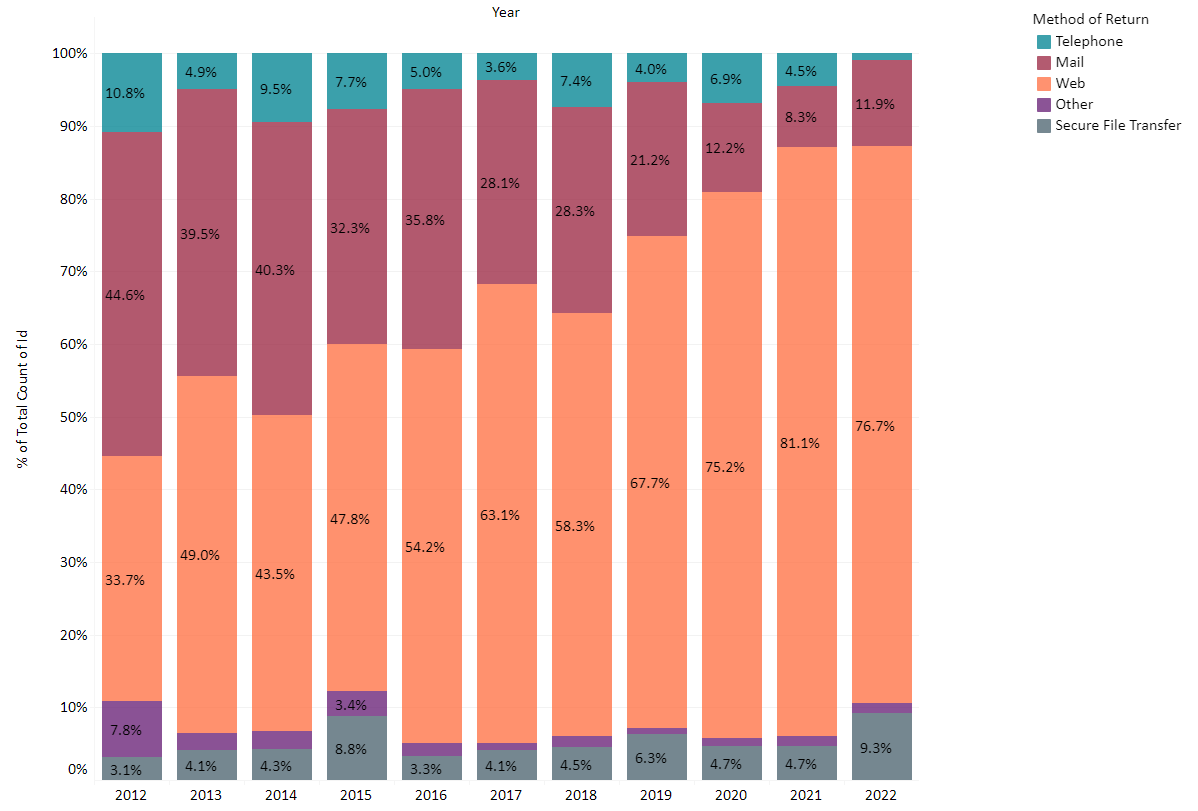
The Web submission option has proven to have growing popularity among respondents. Since the commencement of the web reporting option in 2011, online data submission increased to 80.6 percent in the latest CJRP collection. This is an increase of 47 percentage points in the proportion submissions by web since the introduction of web collection, making it the most popular method of return (see Table 1). In this same timeframe, mailed submissions have dropped to 11.8 percent. The remaining 7.6 percent of submissions were received via fax, phone, or e-mail during non-response follow-up.
Table 1. Distribution of Method of Response
|
2023 CJRP Percent |
2022 JRFC Percent |
Total |
|
|
Web |
80.6% |
76.7% |
11.8% |
11.9% |
|
Phone |
0.8% |
0.9% |
Other |
6.8% |
10.6% |
Figure 1. Method of Response by Collection Year for Separate CJRP and JRFC Data Collections (Percent)
Efforts to Identify Duplication
NIJ, OJJDP, and the Census Bureau take numerous steps to identify all sources of statistical information on youth involved in the juvenile justice system; however currently, no other entity routinely and systematically collects the type of data on juveniles in custody or juvenile residential facilities found in the JFCP and required by Congress. Indeed, other federal agencies often turn to NIJ and OJJDP for information on the trends in and characteristics of juveniles in correctional and other residential placement facilities and the conditions of their confinement.
In an effort to avoid duplication and assist its sister agencies, NIJ and OJJDP have collaborated with (or recently assisted) the Bureau of Justice Statistics (BJS), U.S. Census Bureau, and Office of Civil Rights (OCR). Specifically, NIJ and OJJDP annually provide BJS with an updated frame of the juvenile residential facilities to sample for the Survey of Sexual Victimization (SSV) as part of BJS’s National Prison Rape Statistics Program. The frame has been used in a similar fashion for BJS’s National Survey of Youth in Custody (NSYC). OJJDP authorizes the Census Bureau to use the JFCP juvenile residential facility frame to inform the Group Quarters section of the Government’s Master Address File, which serves as the basis of the Decennial Census. NIJ and OJJDP have also assisted the Department of Education (ED)’s Office of Civil Rights (OCR) Civil Rights Data Collection (CRDC) efforts. Currently the CRDC does not collect data from juvenile facilities, nor any information about the youth housed in these facilities. While Census confidentiality statutes, as well as the “Federal Assurance of Confidentiality” sent to each facility, limits the information that OJJDP can share for non-research (i.e., civil rights enforcement) purposes, OJJDP consulted with its Office of General Counsel (OGC) and determined that it could share the list of public juvenile facilities with OCR, which was done in 2015, 2021, and 2024.
The BJS, Decennial Census, and ED collections have different purposes, priorities, and schedules than the JFCP. BJS’s SSV is collected annually and is a complete enumeration of all state-operated facilities and a sample of locally run facilities. BJS’s NSYC collects data on the incidence and prevalence of sexual assault in juvenile facilities under the Prison Rape Elimination Act of 2003 (PREA; P.L. 108-79) and is collected episodically. In comparison, the JFCP focuses on a much broader spectrum of the characteristics and legal attributes of juveniles in placement for an offense and the conditions of their confinement and is collected on a biennial basis. The Decennial Census is collected every ten years and counts every person living in the United States, including those residing in group quarters. The collection is less frequent than the JFCP limiting the ability to track trends, and it does not collect information about the juvenile residential facilities or justice-related characteristics of youth such as offense, placement authority, adjudication status, or length of stay. The Department of Education’s CRDC collection is used for “monitoring efforts regarding equal educational opportunity.”
Finally, to ensure this information is not collected by other non-federal entities, the NIJ, OJJDP, and the Census Bureau continue to monitor the research literature. All such reviews have indicated that JFCP-type information is not independently available through other means. While some states and localities maintain similar information, it is often incomplete and such localized information sources do not cover the entire country, which is the intent of the JFCP.
This is also true for the new items being added to the JFCP. A panel of experts (see Attachment H) were consulted to identify new content that is needed but not collection on the national level.
Experts acknowledged that the medical needs of youth in residential facilities is a growing policy issue and the reauthorized JJDPA requires facilities to report information on pregnant youth in custody. Previously, information on physical health needs of youth in residential facilities was collected infrequently through the JRFC with the last administration in 2006.
Experts identified training of staff as an important topic, yet there is no comprehensive national collection of training requirements or offerings in juvenile residential facilities.
While external organizations such as the Center for Improving Youth Justice, through the Performance-based Standards program, and local and state governments have reported length of stay in residential facilities for limited samples of facilities, there is no comprehensive national effort to collect data and track length of stay.
Efforts to Minimize Burden
As noted above in Section 3, efforts have been made in the design of the JFCP to minimize burden. The JFCP consolidates two separate data collections into a single data collection with rotating content modules. The consolidation includes removing questions that were duplicated across the two prior surveys and are not critical to maintaining an accurate frame and reformulating statutorily mandated and vital content to be asked in rotating modules. Additionally, several questions were removed to keep respondent burden down prior to the consolidation.
Respondents are given the option of submitting data electronically through the Census Bureau’s secure, online data collection application. The Web reporting option reduces respondent burden by building in automatic skip patterns based on answers to previous items and allows for internal edit checks. The system also allows for respondents to complete the form at their convenience and in multiple sessions, if needed.
The online collection instrument will provide respondents with a printable, pdf version of the form. This provides respondents with the opportunity to circulate the instrument if it requires more than one facility component to contribute to the data response. During the cognitive interviews, respondents that reported via paper form noted that this would be a sufficient alternative to receiving a mailed, paper copy.
Respondents are provided the statement of statutory and policy protections of confidentiality, as well as the burden statement along with the request letter. As part of the collection process, respondents are encouraged to read the frequently asked questions in the “FAQs” section of the Census Bureau’s online form or call a 1-800 number for assistance with electronic submissions (See Attachment G).
Since this is a facility-based census, the aim is to obtain one completed form for each facility. However, many states have identified a designated central reporter, who is then responsible for completing and sending in the forms for some or all public facilities. Similarly, some private agencies operate more than one juvenile facility and have indicated that they can serve as an umbrella reporter to receive and complete forms for all their designated facilities. As such, the Census, OJJDP, and now NIJ have worked with states and agencies to identify “central reporters” who can report for multiple respondents, wherever possible. This approach reduces respondent burden and helps to standardize the responses by agency so that they are consistent, and errors are minimized.
We acknowledge that adding an additional roster to collect information on the Length of Stay (LOS) will noticeably increase the burden on respondents. We explored the feasibility of collecting aggregate rather than individual LOS information during the cognitive interviews. However, respondents overwhelmingly preferred reporting individual-level information on LOS due to the lower quality and significance of the aggregate data, specifically the inability to identify critical variations among youth that affect LOS.
Consequences of Less Frequent Collection
If the JFCP does not proceed, NIJ and OJJDP will not have the capacity to respond to Congressional and Presidential reporting mandates for the Department. This includes mandates in the Juvenile Justice Delinquency Prevention Act (see Attachment C). Larger, more burdensome data collections would be needed to address the issues covered in this collection; and federal, state, and local policymakers would need to rely on anecdotes or incomplete and inaccurate data rather than on federally collected data in developing juvenile justice policy. Without this data collection, comparable national and state-level data would not be available to policymakers, practitioners, and the general public; and OJJDP, federal, state and local agencies would not have important information to develop programs for youth in residential placement, identify training and technical assistance needs, and monitor trends in juvenile placement populations and characteristics.
Without the JFCP, there would be no ability to provide a current, comprehensive juvenile facility frame for related federal, sample-based data collections that are also required by statute, as noted previously in Section 3. Additionally, a number of other federal agencies and initiatives rely on JFCP data for their own reports and publications, and without this collection these efforts to understand and track information on juvenile facilities and the youth in placement would be severely hampered.
A variety of non-federal entities have also analyzed and disseminated JFCP data, including but not limited to the Annie E. Casey Foundation’s National KIDS COUNT Project, the Pew Charitable Trusts Public Safety Performance Project issue briefs, the Child Trends DataBank, The Sentencing Project, the Prison Policy Initiative, and the MacArthur Foundation funded Juvenile Justice, Geography, Policy, Practice & Statistics website.
The changes being proposed to this data collection will increase their use and utility. Moving the reference date from October to March will decrease the perceived lag time between the data year and year of release by allowing data to be released the following year. Rotating content modules will provide flexibility to address contemporary questions while minimizing respondent burden.
Special Circumstances Influencing Collection
The special circumstances listed in the instructions for OMB Form 83-I do not apply to this data collection for the following reasons:
Each module will be administered biennially, in alternating years, as part of a continuous two-year census cycle.
The respondents will have more than 30 days to respond;
Only one copy of the document will be requested;
The collection does not require respondents to maintain records beyond the data collection itself;
Each module is designed as a census of juvenile residential facilities and those youth in custody of those facilities on the reference date and, as such, will produce valid and reliable results;
NIJ will not require reporting of statistical data that have not been approved by OMB;
The pledge of confidentiality provided with the data collection derives directly from statute (see Attachment I for 34 U.S.C. 10231); and
The collection does not request proprietary information.
Adherence to 5 CFR 1320.8(d) and Outside Consultation
The Department of Justice announced the data collections in the Federal Register in accordance with 5 CFR 1320.8(d). The 60-day Federal Register notice was published on May 21, 2024 (89 FR 44709). The 30-day Federal Register notice was submitted to the Federal Register on November 28, 2025, 90 FR 54764, and open for public comments until December 28, 205. NIJ would have responded to all questions and comments on the collections; however, no public comments have been received to date in response to this notice.
During the development phases of this project, OJJDP consulted extensively with experts in the field. These consultants provided expert advice on the operations and population of the specific facilities. Currently, NIJ social scientists consult with OJJDP programmatic staff as well as staff at the Census Bureau and experts at the National Center for Juvenile Justice to determine the value of the information being collected, the phrasing and content of questions, and the form structure. NIJ and OJJDP also rely on experts in the field of juvenile corrections to advise the agencies regarding needed changes, deletions, or additions to the form. This information is gathered through conferences, regional meetings with State Juvenile Justice Specialists, quarterly meetings of the Council of Juvenile Justice Administrators, and internal agency meetings. A list of the individuals directly involved in informing the JFCP is included in Attachment H.
Content changes were informed by broad-scale consultation and testing efforts over four years. In 2020, RTI, in collaboration with NIJ and OJJDP, convened 12 experts with varying roles and experiences related to the juvenile justice, key Department staff, and staff from the National Center for Juvenile Justice to comprehensively review the CJRP and JRFC survey items and identify the importance of existing topics; if existing questions should remain the same, be edited or be removed; if questions should be added to existing topics; and if new topics should be added to either questionnaire. Detailed findings can be found in the report referenced in Section 1.a (https://www.ojp.gov/pdffiles1/nij/grants/304796.pdf). In 2023 and 2024, OJJDP and the Census Bureau’s Data Collection and Methodology Research Staff worked together to improve the questionnaires for the juvenile collections. Staff utilized cognitive interviewing and unmoderated testing to garner feedback on items for possible inclusion to and removal from the two surveys based on the findings of the work done by RTI and feedback from NCJJ. Detailed findings can be found in the report in Attachment E starting on page 15 of the report. The findings from these efforts informed decisions on content to remove or rotate when consolidating the CJRP and JRFC.
Federal social science staff at NIJ (and previously at OJJDP) connect with JFCP respondents at national conferences and meetings, including:
The National Juvenile Court Data Archive workshops, most recently in 2015 (Burlington, VT), 2016 (Louisville, KY), 2017 (Tempe, AZ), and 2018 (Greenville, SC). In a significant number of states data providers for juvenile court data also provide juvenile corrections data, so the workshops are an important venue to discuss common issues and topics such as data sharing and privacy/security concerns.
The Council of Juvenile Correctional Administrators Winter Meetings in 2018, 2019, 2022, 2023, 2024, and 2025. State juvenile correctional agency administrators have historically been critical to JFCP collections, either as direct data contributors or as the key authority for encouraging facility participation. These meetings provide an opportunity to educate and inform the field about the latest data from the national juvenile corrections data collection efforts; to encourage engagement and participation from state agency administrators; to discuss strategies for improving the quality, coverage, and timeliness of the data; and to share data resources.
Since the first collection in 1997, OJJDP and the Census Bureau have developed and maintained a broad range of formal and informal relationships with the data providers. These data providers serve as a network of support for the project by providing updates on facility lists, comments on publications, information about juvenile corrections, reviewers for questionnaire drafts, and participants in the cognitive testing of survey items. The Census Bureau has worked with data providers to help them set up reporting systems that fit with the JFCP reporting mechanisms, thereby decreasing the burden on multiple data providers. The collections’ histories of high response rates and the ongoing, annual use by other federal agencies and the public demonstrate its ongoing value, utility, and relevance for the field.
Paying Respondents
NIJ and OJJDP do not compensate respondents who participate in this data collection. Participation is voluntary.
Assurance of Confidentiality
All information tending to identify individuals (including entities legally considered individuals) will be held strictly confidential according to Title 34, United States Code Section 10231. A copy of this section is included with this submission as Attachment I. Regulations implementing this legislation require that NIJ and OJJDP staff and contractors maintain the confidentiality of the information and specify necessary procedures for guarding this confidentiality. These regulations (28 CFR Part 22) are also included in Attachment J. The request letter sent to respondents for each survey notifies persons responsible for providing these data that their response is voluntary and the data will be held confidential. A copy of these letters, along with the necessary notification is included in Attachment K in this package.
Justification for Sensitive Questions
NIJ and OJJDP’s interests would not be served if many facilities declined participation due to particularly sensitive questions. Therefore, the Census Bureau, NIJ, and OJJDP have paid particular attention to the views of the respondents toward particular issues and questions. All questions deemed too inflammatory or sensitive were removed (such as questions about severe disciplinary actions) during the pretesting stage. The final tests of the questionnaire, as well as each census administration to date, indicate that most respondents do not consider the questions too intrusive or sensitive. However, one set of questions still has a sensitive nature: the final section on deaths in the facility.
Congress mandates in the JJDP Act that OJJDP report on the number of deaths to youths in custody. Under Section 207 of the Act, Congress requires OJJDP to include in its annual report the number of juveniles who died while in custody and the circumstances under which they died. OJJDP previously asked about the annual number of deaths to youths in custody on the Census of Public and Private Juvenile Detention, Correctional, and Shelter Facilities, the precursor to JFCP. Since 2000, the JRFC was the mechanism used by OJJDP to gather detailed information on deaths in custody. The CJRP was used to gather aggregate data on the number of juveniles who died while in custody. The JFCP will continue to collect this information, with detailed information on deaths in custody collected on a rotating basis in the Facility Operations module.
In 2022, the most recent year for which there is final data, facilities reported 3 deaths. While juvenile deaths in custody are rare, they can be indicative of the conditions in the facilities. to develop policies affecting the safety and security of persons in these facilities, it is vital to know what circumstances can potentially lead to death. During the two stages of interviews and the feasibility test undertaken to develop and test the JFCP, as well as all administrations of the censuses so far, no facility has indicated any problem with reporting the death of a youth under their care. Even in cases where the death may have been preventable, the facilities have sufficient trust in the Census Bureau, NIJ, and OJJDP to report these instances. As with any confidential data, NIJ and OJJDP take all due precautions to assure that information of this kind which facilities consider sensitive will not be released in such a way as to disclose the facility involved.
Estimate of Respondent Burden
The total estimated number of respondents is 1,636. It takes an average of 4 hours to complete the Youth Characteristics module and an average of 2 hours to complete the Facility Operations module for a total average of 6 hours to complete the JFCP across the two-year collection cycle. (see table for additional detail.) The total collection burden is 9,816 total hours for 2025 Juvenile Facility Census Program.
Table 2. Estimated Burden Hours
Activity |
Number of Respondents |
Total Annual Responses |
Time per response (hours) |
Total burden (hours) across two-year collection |
2025 JFCP – Youth Characteristics Module (Currently in the field as the 2025 CJRP) |
1,636 |
1,636 |
4 |
6,544 |
2025 JFCP – Facility Operations Module |
1,636 |
1,636 |
2 |
3,272 |
Total Burden |
3,272 |
3,272 |
|
9,816 |
Estimate of Respondent’s Cost Burden
The forms were designed so as not to require any new systems or efforts on the part of respondents. Rather, respondents provide information that are already needed for their own operational functions. As such, this data collection requires no startup costs or maintenance costs from respondents.
Costs to Federal Government
The estimated annual cost for the Juvenile Facility Census Program is $1,142,155. For a breakdown of costs, see Table 3 below.
Table 3. Breakdown of annual costs
OJJDP/NIJ Annual Costs |
|
||
|
Staff Salaries |
|
|
|
|
GS-14 Statistician (5%) |
7,650 |
|
|
GS-15 Supervisory Statistician (1%) |
1,800 |
|
|
Subtotal Salaries |
9,450 |
|
Fringe benefits (28% of salaries) |
2,646 |
|
|
Data Analysis Cooperative Agreement |
40,000 |
|
Subtotal OJJDP/NIJ Costs |
52,096 |
||
Data Collection Agent Costs |
|
||
|
Data collection agent costs (salaries, fringe benefits, web survey, email, and telephone follow-up, programming, and overhead) |
1,090,059 |
|
Total Annual Costs |
1,142,155 |
||
Reasons for Change in Burden
The burden estimate reflects updates made to the two previous, separately approved data collection instruments: CJRP (OMB# 1121-0218) and JRFC (OMB# 1121-0219), and the process of consolidating the collections into a single, uniform program with rotating content modules administered separately during a two-year collection cycle: the Youth Characteristics Module and the Facility Operations Module. The changes to CJRP and JRFC were developed based on recommendations from the report and cognitive testing done by RTI and the Census Bureau, respectively. The following are the changes made to the prior data collections that affected the burden estimate:
CJRP:
Three questions were removed from Section 1, and two questions were added.
A new section, Section 3 “Released Youth” was added, containing ten questions to be answered for each youth (meeting certain criteria) who was released from the facility in the month of February.
JRFC:
Twelve questions were removed from Section 1, and five questions were added.
Five questions were removed from Section 2 (two of which were relocated to the new Section 5), and two questions were added.
Four questions were removed from Section 3.
One question was removed from Section 4.
Nine questions were removed from Section 5.
A new section, Section 5 “Medical Services” was added, containing nine questions. Seven of the questions are new, with two of the questions relocated from Section 2.
No additional changes are proposed to the CJRP to consolidate the surveys because data collection conducted under the prior clearance has concluded and the next JFCP – Youth Characteristics module will not be conducted under this clearance. The following proposes changes to consolidate the JRFC into the JFCP – Facility Operations module:
Remove three questions on information shared upon departure (original form Section 2 [Mental Health Services], Question 15; Section 3 [Educational Services], Question 7a and b; Section 4 [Substance Use Services], Question 10a and b).
Rationale: these questions are infrequently used in OJJDP publications and contribute to survey length with without significant analytic value due to their limited scope. NIJ and OJJDP will explore and test new approaches for collecting information on information sharing of youth service needs that address the needs of the Department and the public.
Reformat population total questions (Section 1, Questions 7, 10, 11, 12, 13) into a matrix-style format.
Rationale: the reorganization will reduce respondent burden and improve data entry efficiency.
Streamline question on suicide risk evaluation by combining subitems to remove screener question (original form Section 2 [Mental Health Services], Question 6).
Rationale: the combining simplifies the question structure and improves the questionnaire flow.
For a full list of changes to each survey, please see Attachment F.
Project Schedule and Publication Plans
NIJ and OJJDP consider publications of the JFCP information important not only for federal agencies, but also for enhancing the work of the facilities themselves. NIJ, with OJJDP funding, manages a comprehensive system for analysis and distribution of the information collected. Under this plan, NIJ manages a cooperative agreement to the National Center for Juvenile Justice for the National Juvenile Justice Data Analysis Program (NJJDAP). The NJJDAP analyzes the JFCP data and produces standard fact sheets, bulletins, and reports for publication and shorter “Data Snapshots” to provide visual representation of data trends. (Please see Attachment L for the most recent Juveniles in Residential Placement Bulletin, Juvenile Residential Facility Census Bulletin, and Data Snapshot.) An additional way that the data are released are via OJJDP’s website through the online Statistical Briefing Book, located at https://ojjdp.ojp.gov/statistical-briefing-book which offers users standard tables and figures, as well as interactive data analysis tools where users can create customized crosstabs.
To promote the publication of research findings from the JFCP and increase their utility to the field, NIJ facilitated panels at the 2022 and 2023 American Society of Criminology Annual Meeting and the 2023 Academy of Criminal Justice Sciences to educate researchers, students, and practitioners about national juvenile justice data availability.
A high-level publication schedule for the Juvenile Facility Census Program is presented in Table 4 below.
Table 4. JFCP publication schedule
Item |
Anticipated Delivery |
JFCP – Youth Population Web Release |
Fall 2026 |
JFCP – Youth Population Snapshot |
Fall 2026 |
Juveniles in Residential Placement, 2025 Statistical Bulletin |
Winter 2026 |
JFCP – Facility Operations Web Release |
Fall 2027 |
JFCP – Facility Operations Snapshot |
Fall 2027 |
To Be Named Statistical Bulletin on Facility Operations |
Winter 2027 |
Display of Expiration Date
The expiration date will be displayed along with the OMB approval number. See Attachment M for an example of the approval number display.
No exceptions to the certification statement are requested or required.
1 This substantive change request will be submitted in September, 2025. Collection for the 2025 CJRP module was conducted under the previously approved clearance. The changes described here will take effect beginning with the Facility Operations module collection in March 2026.
| File Type | application/vnd.openxmlformats-officedocument.wordprocessingml.document |
| File Modified | 0000-00-00 |
| File Created | 2025-12-05 |
© 2026 OMB.report | Privacy Policy