Supplementary Supporting Statement Part A - Objective Yield Program Changes - Apr 2024
0088-OY-2024 Program Changes -Supplemental SSA-04-10-2024.docx
Objective Yield Surveys
Supplementary Supporting Statement Part A - Objective Yield Program Changes - Apr 2024
OMB: 0535-0088
Supplemental Supporting Statement – Part A
OBJECTIVE YIELD SURVEYS
Substantive Change
OMB No. 0535-0088
This substantive change is being submitted as a supplemental supporting statement for program changes beginning with the 2024 production year. The program changes to be implemented include changes due to
1) Every five years NASS conducts a program review following the completion of the Census of Agriculture. NASS considered public input requested through a program review announcement released on Dec. 19, 2023 for these changes, and
2) Each year, NASS reviews the final appropriated budget levels to determine what changes, if any, are needed in its programs. NASS conducted this review for the remainder of FY2024 after it received its final FY2024 appropriation.
This substantive change is to accommodate the program changes that affect this ICR – discontinuation of the cotton objective yield survey.
A. JUSTIFICATION
1. Explain the circumstances that make the collection of information necessary. Identify any legal or administrative requirements that necessitate the collection. Attach a copy of the appropriate section of each statute and regulation mandating or authorizing the collection of information.
The program changes balance resources across all of the programs included in the annual estimating program while ensuring NASS’ annual statistical program aligns with its appropriation.
The program changes are summarized in the following Agricultural Statistics Board Notices:
April 4, 2024 “NASS announces program changes following five-year review” at this link: https://www.nass.usda.gov/Newsroom/Notices/2024/04-04-2024.php
April 9, 2024 “NASS discontinues select 2024 data collection programs and reports” at this link: https://www.nass.usda.gov/Newsroom/Notices/2024/04-09-2024.php
The primary function of the National Agricultural Statistics Service (NASS) is to prepare and issue current official State and national estimates of crop and livestock production, disposition, and prices. General authority for these data collection activities is granted under U.S. Code Title 7, Section 2204 which specifies that "the Secretary of Agriculture shall procure and preserve all information concerning agriculture which he can obtain ... by the collection of statistics ... and shall distribute them among agriculturists."
Data from the field crops information collection provides yield estimates for corn, soybeans, and wheat. The Objective Yield (OY) Survey provides unbiased input by utilizing plant counts and other measurements during the growing season. Accurate yield estimates are extremely important because they are used in conjunction with price data to estimate production and value which are used in making policy decisions. Data is collected in major producing States for corn, soybeans, and winter wheat. Major producing States are States that, when combined, produce over 75 percent of the respective commodities.
Data from the citrus and nut surveys provides projected yield estimates for almonds, hazelnuts, walnuts, and citrus. California accounts for nearly 100% of the US production of almonds and walnuts. Oregon accounts for nearly 100% of the US production for hazelnuts. California and Florida combined account for approximately 95% of the US production of citrus. The citrus and nut objective yield surveys are conducted under cooperative agreements with State Departments of Agriculture and commodity marketing boards.
The authority for staff from the Florida Department of Agriculture and Consumer Services (FDACS) to enter citrus operations to conduct observations and measurements for the Florida Citrus Objective Yield Program is defined in Chapter 601.29(2), Florida Statutes, Florida Citrus Code.
2. Indicate how, by whom, and for what purpose the information is to be used. Except for a new collection, indicate the actual use the agency has made of the information received from the current collection.
There are no changes from the original approval for the purposes of program changes.
3. Describe whether, and to what extent, the collection of information involves the use of automated, electronic, mechanical, or other technological collection techniques or other forms of information technology, e.g., permitting electronic submission of responses, and the basis for the decision for adopting this means of collection. Also describe any consideration of using information technology to reduce burden.
There are no changes from the original approval for the purposes of program changes.
4. Describe efforts to identify duplication. Show specifically why any similar information already available cannot be used or modified for use for the purposes described in Item 2 above.
There are no changes from the original approval for the purposes of program changes.
5. If the collection of information impacts small businesses or other small entities (Item 5 of OMB Form 83-I), describe any methods used to minimize burden.
There are no changes from the original approval for the purposes of program changes.
6. Describe the consequence to Federal program or policy activities if the collection is not conducted or is conducted less frequently, as well as any technical or legal obstacles to reducing burden.
There are no changes from the original approval for the purposes of program changes.
7. Explain any special circumstances that would cause an information collection to be conducted in a manner inconsistent with the general information guidelines in 5 CFR 1320.5.
There are no changes from the original approval for the purposes of program changes.
8. Provide a copy and identify the date and page number of publication in the Federal Register of the agency's notice, required by 5 CFR 1320.8 (d), soliciting comments on the information collection prior to submission to OMB. Summarize public comments received in response to that notice and describe actions taken by the agency in response to these comments.
The Notice soliciting comments was published in the Federal Register on November 4, 2022, on pages 66258-66259. NASS received one public comment, Dr. Dennis Fixler, Chief Statistician for the Bureau of Economic Analysis strongly supports the NASS Objective Yield Survey Program.
Describe efforts to consult with persons outside the agency to obtain their views on the availability of data, frequency of collection, the clarity of instructions and recordkeeping, disclosure, or reporting format (if any), and on the data elements to be recorded, disclosed, or reported.
There are no changes from the original approval for the purposes of program changes.
9. Explain any decision to provide any payment or gift to respondents.
There are no changes from the original approval for the purposes of program changes.
10. Describe any assurance of confidentiality provided to respondents and the basis for the assurance in statute, regulation, or agency policy.
There are no changes from the original approval for the purposes of program changes.
11. Provide additional justification for any questions of a sensitive nature.
There are no changes from the original approval for the purposes of program changes.
12. Provide estimates of the hour burden of the collection of information. The statement should indicate the number of respondents, frequency of response, annual hour burden, and an explanation of how the burden was estimated. If this request for approval covers more than one form, provide separate hour burden estimates for each form and aggregate the hour burdens in Item 13 of OMB Form 83-I. Provide estimates of annualized cost to respondents for the hour burdens for collections of information, identifying and using appropriate wage rate categories.
A description of the forms used in this docket is included in Item 16 below. Only Form A for each crop creates a respondent burden. Forms B, C, E, Q, and R are used to record counts and measurements made by enumerators in the field or laboratory and are included only to provide a complete picture of the objective yield program.
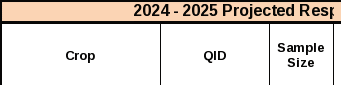
Burden hours based on the average completion time per questionnaire are summarized below.
Cost to the public of completing the questionnaire is assumed to be comparable to the hourly rate of those requesting the data. Reporting time of 4,062 hours is multiplied by $42.75 per hour for a total cost to the public of $173,650.50.
NASS uses the Bureau of Labor Statistics’ Occupational Employment Statistics (most recently published on April 3, 2024 for the previous May) to estimate an hourly wage for the burden cost. The May 2023 mean wage for bookkeepers was $23.84. The mean wage for farm managers was $43.35. The mean wage for farm supervisors was $29.23. The mean wage of the three is $32.14. To calculate the fully loaded wage rate (includes allowances for Social Security, insurance, etc.) NASS will add 33% for a total of $42.75 per hour.
13. Provide an estimate of the total annual cost burden to respondents or record keepers resulting from the collection of information.
There are no capital/start-up or ongoing operation/maintenance costs associated with this information collection.
14. Provide estimates of annualized cost to the Federal government; provide a description of the method used to estimate cost which should include quantification of hours, operational expenses, and any other expense that would not have been incurred without this collection of information.
The total federal cost for 2023 through 2025 are expected to be $4.8 million. This includes an estimated $0.5 million reduction due to the discontinuation of the cotton objective yield survey. The total cost includes all expenses for Federal salaries, NASDA field enumerator costs, training State and Regional Field Office staff, mileage, telephone, printing, overhead, and other miscellaneous costs.
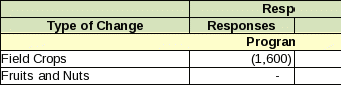
15. Explain the reasons for any program changes or adjustments reported in Items 13 or 14 of the OMB Form 83-I (reasons for changes in burden).
The changes in burden and responses from the program changes are shown in the table below.
16. For collections of information whose results will be published, outline plans for tabulation and publication. Address any complex analytical techniques that will be used. Provide the time schedule for the entire project, including beginning and ending dates of the collection of information, completion of report, publication dates, and other actions.
Field Crops
The following table summarizes the purpose and timing of each form used in collecting objective yield data for the field crops (corn, soybeans and wheat).
Survey Forms for All Field Crops |
||
Form |
Timing |
Purpose |
A |
Initial visit |
Interview to obtain acreage information; permission to enter the sample field and make counts and measurements; cropping practice information including planting date, planter row width, seeding practices, irrigation use, and application of pesticides. |
B |
Monthly |
To record field observations and counts. |
|
When sample arrives in National Lab. |
To record lab counts and weights for corn, soybeans, and wheat samples. |
C-1 |
When sample arrives in National Lab. |
To record lab counts and weights for corn, soybeans, and wheat samples. |
C-2 |
When sample arrives in National Lab. |
Record lab determination for final pre-harvest visit for corn, and wheat samples. |
E |
Within 3 days following farmer harvest of target field. |
To record harvest loss information. |
Q-1 & Q-1W |
Monthly |
For supervisors to record quality check counts. Q-1 is for all crops except wheat. Q-1W is for wheat samples. |
Q-3 |
Daily |
Lab staff test the accuracy of scales at the start of each day. |
Q-6 |
Annually |
Supervisors test the accuracy of scales at the start of each season. |
Crop |
National Lab |
States Served |
Wheat |
St. Louis, MO |
All States |
Corn |
St. Louis, MO |
All States |
Soybeans |
St. Louis, MO |
All States |
The Objective Yield Survey field work begins in late April for winter wheat and late July for corn, and soybeans. Survey results are tabulated the first week of the following month and used to set that month's yield forecast.
Sample fields for field crop objective yield surveys are selected from acreage reported on the June Area Survey and the March Agricultural Survey, depending on the crop type as described below (OMB No. 0535-0213). For corn and soybeans the acres reported in the June Area Survey are adjusted to an estimate of acres for harvest by computing a ratio of acres for harvest in the tract as reported on the OY survey to total acres planted in the tract. The direct expansion estimate from the June Area Survey is then multiplied by the ratio for an indication of acres for harvest.
For winter wheat, sample fields are selected from acreage for harvest reported on the March Agricultural Survey (also OMB No. 0535-0213). Acres for harvest as grain are adjusted by computing a ratio of acres for harvest on the sampled farm at the time of the initial objective yield interview compared to those same acres reported in March.
Averages from sample counts, measurements, and weights are correlated with final pre-harvest plot yields to forecast yield. These indications are used as an independent indication which the aggregate of the objective yield State estimates must total. At the State level, objective yield indications are used in conjunction with the monthly (probability) Agricultural Yield Surveys (OMB No. 0535-0213).
Monthly production estimates during the growing season are published in the Agency's Crop Production release
https://usda.library.cornell.edu/concern/publications/tm70mv177?locale=en
Monthly releases are issued between the 8th and 12th of each month. End-of-season estimates are issued in mid-January in the Annual Summary of Crop Production release
https://usda.library.cornell.edu/concern/publications/k3569432s?locale=en
Citrus
The following table summarizes the purpose and timing of each form used in collecting citrus objective yield data.
Survey Forms for Citrus Crops |
||
Form |
Timing |
Purpose |
Permission Form – California |
Initial visit Valencia – January Clementines – January Navel – July Mandarins – July |
Interview to verify 1) acreage, 2) variety information, 3) year planted, 4) plant spacing, and 5) number of acres in the block. The enumerator will obtain permission to enter the sample field to make counts and measurements. |
Random Path Sheet – California |
Valencia – January Clementines – January Navel – July Mandarins – July |
Guide to randomly select intermediate and terminal branches. These fruit on these branches will be counted and measured to represent the tree. |
Size Card – California |
Valencia – January Clementines – January Navel – July Mandarins – July |
To record diameter size of the selected fruit. Ten fruit are measured per tree for four trees. Size data is collected on every third sample. |
Tree Inventory: Initial Telephone Contact Script - Florida |
July |
Inform caretaker will be entering grove to verify tree counts, varieties, and spacing measurements between rows. Updates are made for geodatabase of citrus groves. |
Citrus Maturity: Initial Telephone Contact Script - Florida |
Monthly July-June |
Inform caretaker will be entering grove to collect fruit samples for maturity test. |
Limb Count Survey: Initial Telephone Contact Script - Florida |
August-September |
Inform caretaker will be entering grove to randomly select trees and limbs for monthly counts and measurements. |
Initial Telephone Contact Script - Florida |
Monthly |
Inform caretaker will be entering grove to make counts and measurements. |
The Citrus Objective yield surveys will be entirely funded by the cooperators, California Department of Food and Agriculture (CDFA) and Florida Department of Agriculture and Consumer Services (FDACS).
Sample fields for citrus objective yield surveys will be selected from databases with field level data on crop, variety, age of tree, and bearing status. The databases are updated using the California Fruit Acreage Survey (OMB No. 0535-0039) and Florida Commercial Tree Inventory Survey that utilizes aerial photography and verification by FDACS staff. Bearing age trees are assumed to be available for harvest.
Averages from fruit per tree, percent remaining to harvest, size measurements, and weights will be correlated with final pre-harvest plot yields to forecast yield. These indications will be used as an independent indication for a forecasted State-level yield. The Citrus Maturity Survey in Florida will provide an additional indication for frozen concentrated orange juice (FCOJ) yield.
Projected production estimates will be published in a release that is published jointly by NASS and the cooperator.
Results of the California Citrus Objective Measurement Survey can be found at
Results of the Florida Citrus Objective Measurement Survey are included in NASS's Crop Production release
https://usda.library.cornell.edu/concern/publications/tm70mv177?locale=en
and at
https://www.nass.usda.gov/Statistics_by_State/Florida/Publications/Citrus/index.php
Nut Crops
The following table summarizes the purpose and timing of each form used in collecting tree nut objective yield data.
Survey Forms for Tree Nut Crops |
||
Form |
Timing |
Purpose |
Permission Form – California |
Initial visit Almond – May Walnut - July |
Interview to verify 1) acreage, 2) variety information, 3) year planted, 4) plant spacing, and 5) number of acres in the block. The enumerator will obtain permission to enter the sample field to make counts and measurements. |
Random Path Sheet – California |
Almond – May Walnut - July |
Guide to randomly select intermediate and terminal branches. These fruit on these branches will be counted and measured to represent the tree. |
Size Card – California |
Almond – May Walnut - None |
To record kernel length, width, cross-width, and weight of the selected fruit. Up to ten fruit per tree are measured for walnuts and up to 20 fruit per tree are measured for almonds. |
Permission Form (Form A) – Oregon |
August |
The enumerator will obtain permission to enter the sample field to make counts and measurements. |
Row and Tree Selection (Form B1) - Oregon |
August |
Estimate the number of trees in the block by observing length and width of the row. Select two trees using random procedure. |
Branch Selection (Form B2) - Oregon |
August |
Select one terminal branch per tree using random procedure. All tree nuts from terminal branch are sampled. |
Laboratory Observations (Form C) - Oregon |
August |
Record number of tree nuts by size and record total weight of sampled tree nuts. |
The Tree Nut Objective yield surveys will be entirely funded by the cooperators, Almond Board of California, California Walnut Board, and Oregon Hazelnut Marketing Board.
Sample fields for tree nut objective yield surveys will be selected from databases with field level data on crop, variety, age of tree, and bearing status. The databases are updated using the California Fruit Acreage Survey (OMB No. 0535-0039) as well as industry provided plantings by year and design using GIS data. Bearing age trees are assumed to be available for harvest.
Averages from fruit per tree, size measurements, and weights will be correlated with final pre-harvest plot yields to forecast yield. These indications will be used as an independent indication for a forecasted State-level yield.
Projected production estimates will be published in a release that is published jointly by NASS and the cooperators.
Results of the California Almond Objective Measurement Survey can be found at
Results of the California Walnut Objective Measurement Survey can be found at
Results of the Oregon Hazelnut Objective Measurement Survey can be found in the Agency’s September Crop Production Report found at
https://usda.library.cornell.edu/concern/publications/tm70mv177 and
https://www.nass.usda.gov/Statistics_by_State/Oregon/Publications/Fruits_Nuts_and_Berries/index.php
17. If seeking approval to not display the expiration date for OMB approval of the information collection, explain the reasons that display would be inappropriate.
No approval is requested for non-display of the expiration date.
18. Explain each exception to the certification statement identified in Item 19, “Certification for Paperwork Reduction Act Submissions” of OMB Form 83-I.
There are no exceptions to the certification statement.
April, 2024
| File Type | application/vnd.openxmlformats-officedocument.wordprocessingml.document |
| File Title | Supporting Statement |
| Author | hancda |
| File Modified | 0000-00-00 |
| File Created | 2026-01-27 |
© 2026 OMB.report | Privacy Policy