0088-oy-23-ssa-12-30-2022
0088-OY-23-SSA-12-30-2022.docx
Objective Yield Surveys
OMB: 0535-0088
Supporting Statement
OBJECTIVE YIELD SURVEYS
OMB No. 0535-0088
This docket is being submitted for revision and extension of three years.
NOTE: The 60-day notice (87 FR 66258) mentioned the following: “The Objective Yield Surveys objectively predict yields for corn, cotton, potatoes, soybeans, wheat, citrus, almonds, walnuts, and hazelnuts.” Potatoes was left in erroneously. Potatoes were removed from the Objective Yield ICR from the substantive change request on February, 2020 (https://www.reginfo.gov/public/do/DownloadDocument?objectID=100742601).
Changes from the currently approved Information Collection Request include:
The California Department of Food and Agriculture (CDFA) requested NASS start collecting data to establish a model to estimate clementine orange production. If funded by CDFA, this will start in January 2024, and
Minor sample size changes to the existing surveys.
A. JUSTIFICATION
1. Explain the circumstances that make the collection of information necessary. Identify any legal or administrative requirements that necessitate the collection. Attach a copy of the appropriate section of each statute and regulation mandating or authorizing the collection of information.
The primary function of the National Agricultural Statistics Service (NASS) is to prepare and issue current official State and national estimates of crop and livestock production, disposition, and prices. General authority for these data collection activities is granted under U.S. Code Title 7, Section 2204 which specifies that "the Secretary of Agriculture shall procure and preserve all information concerning agriculture which he can obtain ... by the collection of statistics ... and shall distribute them among agriculturists."
Data from the field crops information collection provides yield estimates for corn, cotton, soybeans, and wheat. The Objective Yield (OY) Survey provides unbiased input by utilizing plant counts and other measurements during the growing season. Accurate yield estimates are extremely important because they are used in conjunction with price data to estimate production and value which are used in making policy decisions. Data is collected in major producing States for corn, upland cotton, soybeans, and winter wheat. Major producing States are States that, when combined, produce over 75 percent of the respective commodities.
Data from the citrus and nut surveys provides projected yield estimates for almonds, hazelnuts, walnuts, and citrus. California accounts for nearly 100% of the US production of almonds and walnuts. Oregon accounts for nearly 100% of the US production for hazelnuts. California and Florida combined account for approximately 95% of the US production of citrus. The citrus and nut objective yield surveys are conducted under cooperative agreements with State Departments of Agriculture and commodity marketing boards.
The authority for staff from the Florida Department of Agriculture and Consumer Services (FDACS) to enter citrus operations to conduct observations and measurements for the Florida Citrus Objective Yield Program is defined in Chapter 601.29(2), Florida Statutes, Florida Citrus Code.
2. Indicate how, by whom, and for what purpose the information is to be used. Except for a new collection, indicate the actual use the agency has made of the information received from the current collection.
The U.S. Department of Agriculture uses the production forecasts to anticipate loan receipts and pricing of loan stocks for grains. The Congress takes into account changing yield and production levels in formulating farm legislation. Farmers and businesses use the production estimates in marketing decisions to evaluate expected prices and to determine when to sell their crops.
These production forecasts are greatly relied upon by the transportation sector, warehouse and storage companies, banks and other lending institutions, commodity traders, and processors. Agribusinesses who provide farmers with inputs, equipment, and other goods and services study reports when planning their marketing strategies. Analysts transform the statistics into projections of trends, interpretations of economic implications, and evaluations of alternative courses of action for producers, agribusinesses, and policy makers.
3. Describe whether, and to what extent, the collection of information involves the use of automated, electronic, mechanical, or other technological collection techniques or other forms of information technology, e.g., permitting electronic submission of responses, and the basis for the decision for adopting this means of collection. Also describe any consideration of using information technology to reduce burden.
The majority of field crop data that are collected through the Objective Yield surveys are collected during visits by NASDA enumerators to the target fields. Only the initial interview (Form A) is conducted with the farm operator. Field-level planted acreage information for the field crop of interest (as reported on the base Agricultural Surveys, OMB No. 0535-0213) are preprinted on the Form A - Interview Forms. Respondents are asked to verify the information and report harvesting intentions for each field. This greatly reduces the amount of time respondents must spend during the initial interview for corn, cotton, and soybeans.
The majority of the tree fruit data that will be collected through the Objective Yield surveys will be collected during visits by enumerators to the target fields. Only the initial interview (Form A or permission form) will be conducted with the farm operator (except for citrus in Florida). Field-level planted acreage information for the crop of interest (as recorded on the fruit and nut acreage sampling frames and updated biennially) will be preprinted on the Form A or permission forms. Respondents will be asked to verify the acreage and variety information. This will greatly reduce the amount of time respondents must spend during the initial interview.
There will be no initial interview for citrus in Florida. Chapter 601.29(2), Florida Statutes, Florida Citrus Code authorizes site visits to Florida’s commercial groves for objective fruit measurements and counts. Initial phone calls will be made prior to each visit to announce the visit and to obtain information about dogs on the property or when chemical spraying is scheduled to take place.
NASS management has directed our programmers and system developers to concentrate their time on the surveys that have a greater amount of respondent burden. At some future date we may look into converting the Form A into an internet or computer based survey, but for now it will remain as a paper questionnaire. As a result of collecting data by phone during the COVID-19 pandemic, there is evidence that the Form A can be completed by phone contact. Therefore, we encourage enumerators to make first contact by phone. If unsuccessful then we have enumerators meet the farmers in person.
4. Describe efforts to identify duplication. Show specifically why any similar information already available cannot be used or modified for use for the purposes described in Item 2 above.
The National Agricultural Statistics Service cooperates with other Federal agencies, State Departments of Agriculture, and land grant universities to conduct agricultural surveys and ensure that identical data are not being collected by other parties. These surveys meet both State and Federal needs, thus eliminating duplication and minimizing reporting burden on the agricultural industry. The types of data collected on these surveys are not available from any other sources.
5. If the collection of information impacts small businesses or other small entities (Item 5 of OMB Form 83-I), describe any methods used to minimize burden.
Operators of sampled field crops will be contacted only on the first visit to verify planted acreage reported on the parent survey; record harvest acreage intentions; and obtain data on planting date, planter row width, seeding practices, irrigation usage, and application of pesticides.
Operators of sampled citrus and nut acres will be contacted only on the first visit to verify who is operating the acres, describe the measurement process during the growing season and ask for permission to harvest the crop from the terminal branch that was selected from two trees in the targeted area of the field. In addition the enumerator will ask for the operator’s plans for spraying chemicals to make sure that it is safe for the enumerator to enter the field(s) during the growing season.
The farmer will be asked for permission to enter the sample field and make counts and measurements for subsequent surveys during the growing season. The farmer will not need to be present for the follow up surveys. The data are collected by trained enumerators and the information requested can usually be provided with a minimum of difficulty and generally without respondents having to consult their record books. (Note, farm operators are encouraged to consult their records if they prefer to do so.)
Small operations are defined by the Small Business Administration in Federal Register 87 FR 18607 at this link: https://www.federalregister.gov/documents/2022/03/31/2022-06604/small-business-size-standards-agriculture-forestry-fishing-and-hunting-mining-quarrying-and-oil-and
For the field crops, approximately 85 percent of the sample are classified as a small operation.
For the fruit and nut crops, between 57 and 99 percent of the sample are classified as small operations.
6. Describe the consequence to Federal program or policy activities if the collection is not conducted or is conducted less frequently, as well as any technical or legal obstacles to reducing burden.
The initial interview (Form A) is needed to confirm field characteristics and to request consent for study participation. Response burden is not affected by frequency of field observations since no further interviews are conducted. Objective yield counts begin as soon as meaningful counts can be made and continue each month until the field is harvested. The field observations need to be conducted each month to monitor changes in maturity during the growing season.
7. Explain any special circumstances that would cause an information collection to be conducted in a manner inconsistent with the general information guidelines in 5 CFR 1320.5.
There are no special circumstances associated with this information collection.
8. Provide a copy and identify the date and page number of publication in the Federal Register of the agency's notice, required by 5 CFR 1320.8 (d), soliciting comments on the information collection prior to submission to OMB. Summarize public comments received in response to that notice and describe actions taken by the agency in response to these comments.
The Notice soliciting comments was published in the Federal Register on November 4, 2022, on pages 66258-66259. NASS received one public comment, Dr. Dennis Fixler, Chief Statistician for the Bureau of Economic Analysis strongly supports the NASS Objective Yield Survey Program.
Describe efforts to consult with persons outside the agency to obtain their views on the availability of data, frequency of collection, the clarity of instructions and recordkeeping, disclosure, or reporting format (if any), and on the data elements to be recorded, disclosed, or reported.
NASS consults with both government and private organizations to determine better methods to accurately predict crop yields. Specifically, NASS Field Offices and Headquarters personnel frequently meet with other governmental agencies, such as Agricultural Marketing Service and World Agricultural Outlook Board, as well as extension agents, cooperatives, and trade associations. NASS statisticians attend private agricultural professional meetings. Data user meetings are held each year as part of the effort by NASS to obtain input from a cross-section of agricultural interests.
Although NASS has not held data user meetings to discuss specifically the Field Crops Objective Yield Surveys, NASS interacts frequently with data users and industry representatives to improve measurement of acreage, yield, production, and other core content areas of the Field Crops Objective Yield Surveys.
With the new citrus and tree nut objective yield surveys our Field Offices have talked with growers associations as well as the State Departments of Agriculture and received input from them.
Specific contacts include:
Field Crops Objective Yield:
John Newton, Ph.D., Chief Economist
American Farm Bureau Federation
202-406-3729 w 502-641-4636 c
www.fb.org
jnewton@fb.org
Florida Citrus Objective Measurement:
Dr. Marisa Zansler, Florida Department of Citrus’ Economic and Market Research Director
Phone: (352) 294-7691
E-mail mzansler@citrus.myflorida.com
California Almond Objective Measurement:
Bryce Spycher, Almond Board of California
Senior Manager, Marketing Order Services
1150 Ninth St., Ste. 1500
Modesto, CA 95354
Phone: (209) 343-3221
California Walnut Objective Measurement:
Robert Verloop, California Walnut Board & Commission
Executive Director/Chief Executive Officer
101 Parkshore Drive, Suite 250
Folsom, CA 95630
Phone: (916) 932-7070
E-Mail: rverloop@walnuts.org
California Citrus Objective Measurement:
Gus Carranza
Sun Pacific
(559) 280-3315
Oregon Hazelnut Objective Yield:
Colleen Nihen, Oregon Hazelnut Industry
Executive Director
hazelnut@oregonhazelnuts.org
(503) 582-8420
No comments or suggestions were received from these contacts.
9. Explain any decision to provide any payment or gift to respondents.
There are no payments or gifts to respondents.
10. Describe any assurance of confidentiality provided to respondents and the basis for the assurance in statute, regulation, or agency policy.
Questionnaires include a statement that individual reports are confidential. U.S. Code Title 18, Section 1905; U.S. Code Title 7, Section 2276; and the Confidential Information Protection and Statistical Efficiency Act of 2018, Title III of Pub. L. No. 115-435, codified in 44 U.S.C. Ch. 35 and other applicable Federal laws. All employees of NASS and all enumerators hired and supervised under a cooperative agreement with the National Association of State Departments of Agriculture (NASDA) must read the regulations and sign a statement of compliance.
The following CIPSEA Pledge statement will appear on all future NASS questionnaires.
The information you provide will be used for statistical purposes only. Your responses will be kept confidential and any person who willfully discloses ANY identifiable information about you or your operation is subject to a jail term, a fine, or both. This survey is conducted in accordance with the Confidential Information Protection and Statistical Efficiency Act of 2018, Title III of Pub. L. No. 115-435, codified in 44 U.S.C. Ch. 35 and other applicable Federal laws. For more information on how we protect your information please visit: https://www.nass.usda.gov/confidentiality.
All individuals who may access these confidential data for research are also covered under Titles 18 and CIPSEA and must complete a Certification and Restrictions on Use of Unpublished Data (ADM-043) agreement.
11. Provide additional justification for any questions of a sensitive nature.
There are no questions of a sensitive nature.
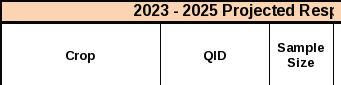
12. Provide estimates of the hour burden of the collection of information. The statement should indicate the number of respondents, frequency of response, annual hour burden, and an explanation of how the burden was estimated. If this request for approval covers more than one form, provide separate hour burden estimates for each form and aggregate the hour burdens in Item 13 of OMB Form 83-I. Provide estimates of annualized cost to respondents for the hour burdens for collections of information, identifying and using appropriate wage rate categories.
A description of the forms used in this docket is included in Item 16 below. Only Form A for each crop creates a respondent burden. Forms B, C, E, Q, and R are used to record counts and measurements made by enumerators in the field or laboratory and are included only to provide a complete picture of the objective yield program.
Burden hours based on the average completion time per questionnaire are summarized below.
Cost to the public of completing the questionnaire is assumed to be comparable to the hourly rate of those requesting the data. Reporting time of 4,410 hours is multiplied by $37.94 per hour for a total cost to the public of $167,315.40.
NASS uses the Bureau of Labor Statistics’ Occupational Employment Statistics (most recently published on March 31, 2022 for the previous May) to estimate an hourly wage for the burden cost. The May 2021 mean wage for bookkeepers was $21.70. The mean wage for farm managers was $37.71. The mean wage for farm supervisors was $26.18. The mean wage of the three is $28.53. To calculate the fully loaded wage rate (includes allowances for Social Security, insurance, etc.) NASS will add 33% for a total of $37.94 per hour.
13. Provide an estimate of the total annual cost burden to respondents or record keepers resulting from the collection of information.
There are no capital/start-up or ongoing operation/maintenance costs associated with this information collection.
14. Provide estimates of annualized cost to the Federal government; provide a description of the method used to estimate cost which should include quantification of hours, operational expenses, and any other expense that would not have been incurred without this collection of information.
The total federal cost for 2023 through 2025 are expected to be $5.3 million. The total cost includes all expenses for Federal salaries, NASDA field enumerator costs, training State and Regional Field Office staff, mileage, telephone, printing, overhead, and other miscellaneous costs.
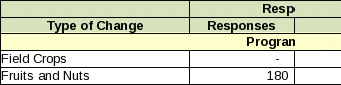
15. Explain the reasons for any program changes or adjustments reported in Items 13 or 14 of the OMB Form 83-I (reasons for changes in burden).
The California Department of Food and Agriculture requested NASS start collecting data to establish a model to estimate clementine orange production. If funded, this will start in January 2024. This is noted as a program change in the below table.
There are minimal changes to the objective yield sample sizes from the previous approval to account for current response rates.
The changes in burden and responses are shown in the table below.
16. For collections of information whose results will be published, outline plans for tabulation and publication. Address any complex analytical techniques that will be used. Provide the time schedule for the entire project, including beginning and ending dates of the collection of information, completion of report, publication dates, and other actions.
Field Crops
The following table summarizes the purpose and timing of each form used in collecting objective yield data for the field crops (corn, cotton, soybeans and wheat).
Survey Forms for All Field Crops |
||
Form |
Timing |
Purpose |
A |
Initial visit |
Interview to obtain acreage information; permission to enter the sample field and make counts and measurements; cropping practice information including planting date, planter row width, seeding practices, irrigation use, and application of pesticides. |
B |
Monthly |
To record field observations and counts. |
|
When sample arrives in National Lab. |
To record lab counts and weights for corn, soybeans, and wheat samples. |
C-1 |
When sample arrives in National Lab. |
To record lab counts and weights for corn, soybeans, and wheat samples. |
C-2 |
When sample arrives in National Lab. |
Record lab determination for final pre-harvest visit for corn, and wheat samples. |
E |
Within 3 days following farmer harvest of target field. |
To record harvest loss information. |
Q-1 & Q-1W |
Monthly |
For supervisors to record quality check counts. Q-1 is for all crops except wheat. Q-1W is for wheat samples. |
Q-3 |
Daily |
Lab staff test the accuracy of scales at the start of each day. |
Q-6 |
Annually |
Supervisors test the accuracy of scales at the start of each season. |
Crop |
National Lab |
States Served |
Wheat |
St. Louis, MO |
All States |
Cotton |
St. Louis, MO |
All States |
Corn |
St. Louis, MO |
All States |
Soybeans |
St. Louis, MO |
All States |
The Objective Yield Survey field work begins in late April for winter wheat and late July for cotton, corn, and soybeans. Survey results are tabulated the first week of the following month and used to set that month's yield forecast.
Sample fields for field crop objective yield surveys are selected from acreage reported on the June Area Survey and the March Agricultural Survey, depending on the crop type as described below (OMB No. 0535-0213). For corn, cotton, and soybeans the acres reported in the June Area Survey are adjusted to an estimate of acres for harvest by computing a ratio of acres for harvest in the tract as reported on the OY survey to total acres planted in the tract. The direct expansion estimate from the June Area Survey is then multiplied by the ratio for an indication of acres for harvest.
For winter wheat, sample fields are selected from acreage for harvest reported on the March Agricultural Survey (also OMB No. 0535-0213). Acres for harvest as grain are adjusted by computing a ratio of acres for harvest on the sampled farm at the time of the initial objective yield interview compared to those same acres reported in March.
Averages from sample counts, measurements, and weights are correlated with final pre-harvest plot yields to forecast yield. These indications are used as an independent indication which the aggregate of the objective yield State estimates must total. At the State level, objective yield indications are used in conjunction with the monthly (probability) Agricultural Yield Surveys (OMB No. 0535-0213).
Monthly production estimates during the growing season are published in the Agency's Crop Production release
https://usda.library.cornell.edu/concern/publications/tm70mv177?locale=en
Monthly releases are issued between the 8th and 12th of each month. End-of-season estimates are issued in mid-January in the Annual Summary of Crop Production release
https://usda.library.cornell.edu/concern/publications/k3569432s?locale=en
Citrus
The following table summarizes the purpose and timing of each form used in collecting citrus objective yield data.
Survey Forms for Citrus Crops |
||
Form |
Timing |
Purpose |
Permission Form – California |
Initial visit Valencia – January Clementines – January Navel – July Mandarins – July |
Interview to verify 1) acreage, 2) variety information, 3) year planted, 4) plant spacing, and 5) number of acres in the block. The enumerator will obtain permission to enter the sample field to make counts and measurements. |
Random Path Sheet – California |
Valencia – January Clementines – January Navel – July Mandarins – July |
Guide to randomly select intermediate and terminal branches. These fruit on these branches will be counted and measured to represent the tree. |
Size Card – California |
Valencia – January Clementines – January Navel – July Mandarins – July |
To record diameter size of the selected fruit. Ten fruit are measured per tree for four trees. Size data is collected on every third sample. |
Tree Inventory: Initial Telephone Contact Script - Florida |
July |
Inform caretaker will be entering grove to verify tree counts, varieties, and spacing measurements between rows. Updates are made for geodatabase of citrus groves. |
Citrus Maturity: Initial Telephone Contact Script - Florida |
Monthly July-June |
Inform caretaker will be entering grove to collect fruit samples for maturity test. |
Limb Count Survey: Initial Telephone Contact Script - Florida |
August-September |
Inform caretaker will be entering grove to randomly select trees and limbs for monthly counts and measurements. |
Initial Telephone Contact Script - Florida |
Monthly |
Inform caretaker will be entering grove to make counts and measurements. |
The Citrus Objective yield surveys will be entirely funded by the cooperators, California Department of Food and Agriculture (CDFA) and Florida Department of Agriculture and Consumer Services (FDACS).
Sample fields for citrus objective yield surveys will be selected from databases with field level data on crop, variety, age of tree, and bearing status. The databases are updated using the California Fruit Acreage Survey (OMB No. 0535-0039) and Florida Commercial Tree Inventory Survey that utilizes aerial photography and verification by FDACS staff. Bearing age trees are assumed to be available for harvest.
Averages from fruit per tree, percent remaining to harvest, size measurements, and weights will be correlated with final pre-harvest plot yields to forecast yield. These indications will be used as an independent indication for a forecasted State-level yield. The Citrus Maturity Survey in Florida will provide an additional indication for frozen concentrated orange juice (FCOJ) yield.
Projected production estimates will be published in a release that is published jointly by NASS and the cooperator.
Results of the California Citrus Objective Measurement Survey can be found at
Results of the Florida Citrus Objective Measurement Survey are included in NASS's Crop Production release
https://usda.library.cornell.edu/concern/publications/tm70mv177?locale=en
and at
https://www.nass.usda.gov/Statistics_by_State/Florida/Publications/Citrus/index.php
Nut Crops
The following table summarizes the purpose and timing of each form used in collecting tree nut objective yield data.
Survey Forms for Tree Nut Crops |
||
Form |
Timing |
Purpose |
Permission Form – California |
Initial visit Almond – May Walnut - July |
Interview to verify 1) acreage, 2) variety information, 3) year planted, 4) plant spacing, and 5) number of acres in the block. The enumerator will obtain permission to enter the sample field to make counts and measurements. |
Random Path Sheet – California |
Almond – May Walnut - July |
Guide to randomly select intermediate and terminal branches. These fruit on these branches will be counted and measured to represent the tree. |
Size Card – California |
Almond – May Walnut - None |
To record kernel length, width, cross-width, and weight of the selected fruit. Up to ten fruit per tree are measured for walnuts and up to 20 fruit per tree are measured for almonds. |
Permission Form (Form A) – Oregon |
August |
The enumerator will obtain permission to enter the sample field to make counts and measurements. |
Row and Tree Selection (Form B1) - Oregon |
August |
Estimate the number of trees in the block by observing length and width of the row. Select two trees using random procedure. |
Branch Selection (Form B2) - Oregon |
August |
Select one terminal branch per tree using random procedure. All tree nuts from terminal branch are sampled. |
Laboratory Observations (Form C) - Oregon |
August |
Record number of tree nuts by size and record total weight of sampled tree nuts. |
The Tree Nut Objective yield surveys will be entirely funded by the cooperators, Almond Board of California, California Walnut Board, and Oregon Hazelnut Marketing Board.
Sample fields for tree nut objective yield surveys will be selected from databases with field level data on crop, variety, age of tree, and bearing status. The databases are updated using the California Fruit Acreage Survey (OMB No. 0535-0039) as well as industry provided plantings by year and design using GIS data. Bearing age trees are assumed to be available for harvest.
Averages from fruit per tree, size measurements, and weights will be correlated with final pre-harvest plot yields to forecast yield. These indications will be used as an independent indication for a forecasted State-level yield.
Projected production estimates will be published in a release that is published jointly by NASS and the cooperators.
Results of the California Almond Objective Measurement Survey can be found at
Results of the California Walnut Objective Measurement Survey can be found at
Results of the Oregon Hazelnut Objective Measurement Survey can be found in the Agency’s September Crop Production Report found at
https://usda.library.cornell.edu/concern/publications/tm70mv177 and
https://www.nass.usda.gov/Statistics_by_State/Oregon/Publications/Fruits_Nuts_and_Berries/index.php
17. If seeking approval to not display the expiration date for OMB approval of the information collection, explain the reasons that display would be inappropriate.
No approval is requested for non-display of the expiration date.
18. Explain each exception to the certification statement identified in Item 19, “Certification for Paperwork Reduction Act Submissions” of OMB Form 83-I.
There are no exceptions to the certification statement.
January, 2023
| File Type | application/vnd.openxmlformats-officedocument.wordprocessingml.document |
| File Title | Supporting Statement |
| Author | hancda |
| File Modified | 0000-00-00 |
| File Created | 2026-01-27 |
© 2026 OMB.report | Privacy Policy