Supporting Statement A Feb 2026
Supporting Statement A Feb 2026.docx
Pilot Medical Disclosure Decision Making Model for Safety Risk Assessment Survey
OMB:
Supporting Statement A
Federal Aviation Administration
Pilot Medical Disclosure Decision Making Model for Safety Risk Assessment Survey
OMB # 2120-XXXX
This is a new effort. There are no changes to report.
Explain the circumstances that make the collection of information necessary. Identify any legal or administrative requirements that necessitate the collection.
The Office of Aerospace Medicine (OAM) requires the development of a model to represent pilot medical-disclosure decision-making to be used by the Safety Risk Management team during current and future safety risk assessments. Following the Mental Health Aviation Rulemaking Committee’s recommendation, OAM and Flight Standards Services (AFS) conducted a joint safety risk assessment of pilot medical non-disclosure in quarter four of fiscal year 2024 and quarter one of fiscal year 2025. Results of their assessment identified the need to validate a model of pilot medical-disclosure decision-making to better estimate safety risks.
To validate a model of pilot medical-disclosure decision-making, there is a need to collect survey-based indicators of factors which may or may not influence pilot decision making regarding their likelihood to disclose physical or mental health symptoms during the aeromedical certification process. The survey will ask pilots about their likelihood to disclose physical and mental health symptoms, and their perceptions of factors that may influence their decision making. Pilots will also have an opportunity to rate the effectiveness of a variety of control actions related to the aeromedical certification process.
The sampling frame will be constructed from all cases of Air Transport Pilots having a certificate listed as issued, rather than deferred or denied, within the AMCS database. A simple random sampling strategy will be used. We will draw a random sample of n 1,950 ATP-certified pilots from the AMCS database, using random numbers to select without replacement.
Sample Size Estimation. A power analysis was conducted using the pwrSEM Shiny application to estimate the minimum sample size required to detect direct and interaction effects in a constrained multi-group structural equation model (SEM). The model includes six latent predictor variables, four latent interaction terms, and one latent outcome variable. All structural paths were constrained to be equal across three randomly assigned survey conditions. The three survey conditions corresponding to hypothetical medical conditions critical to aviation safety. Participants will be asked to respond to survey items with one of the three medical conditions in mind.
Indicate how, by whom, and for what purpose the information is to be used. Except for a new collection, indicate the actual use the agency has made of the information received from the current collection.
To validate a new research informed model of pilot medical-disclosure decision-making, we will use a survey to collect information from Air Transport Pilot (Part 121). We will use a voluntary online survey to collect information. We will invite a random sample of Airline Transport Pilots represented in a 2023 aerospace medical certification database. The 2023 database is the most up-to-date medical certification database in researchers possession. This will be a one-time data collection effort.
The information to be collected will be in the form of Air Transport Pilot responses to survey items asking about:
Beliefs related to health symptom disclosure and aeromedical certification processes
Perceptions of proposed control measures for mitigating pilot medical symptom non-disclosure.
Demographics to include age, sex, and occupational characteristics. Any demographic information disseminated to the public will be presented in aggregate form.
Results and information collected from the survey will be briefed to project sponsors (AVS/AAM), the Safety Risk Management team, and the Federal Air Surgeon. All information collected from the survey will be used by OAM and the Safety Risk Management team (SRM) to:
Aid in future safety risk assessments regarding the likelihood of pilot medical non-disclosure
Validate a model of pilot medical disclosure decision-making
Inform the development of new control measures to mitigate the risk of pilot medical non-disclosure
Assess Part 121 pilot satisfaction with potential control measures related to the aeromedical certification process.
Publication of all data may be presented in aggregate form:
Within a peer-reviewed journal article in aggregate form
At scientific meetings or conferences
It is anticipated that the information collected will be disseminated to the public or used to support publicly disseminated information. FAA OAM will retain control over the information and safeguard it from improper access, modification, and destruction, consistent with FAA standards for confidentiality, privacy, and electronic information. See response to Question 10 of this Supporting Statement for more information on confidentiality and privacy. The information collection is designed to yield data that meet all applicable information quality guidelines.
Describe whether, and to what extent, the collection of information involves the use of automated, electronic, mechanical, or other technological collection techniques or other forms of information technology.
Invitation to participate in the survey will be delivered by e-mail and postal service mail, and 100% pilots invited to participate in the survey will be asked to complete the survey online. Invitation letters will include information on how to complete the survey online via unique internet address. Responses to the survey will be anonymous and no personally identifying information will be collected. Once a participant submits their response to the online survey, they will no longer have access to the survey. Participants may contact the researcher and request a link to access their response if they need to make changes.
The online survey will be available to be completed 24/7 for 365 days from when the invitation was originally mailed or until respondent quota is met, whichever occurs first. Reminders to complete the survey will be sent to non-responders via e-mail, at 2-week intervals during the data collection period. Recipients will be given the option to ‘opt out’ of receiving additional reminders.
Finally,
results of the survey may be presented over the internet via online
scientific journals and the OAM technical report series.
Describe efforts to identify duplication. Show specifically why any similar information already available cannot be used or modified for use for the purposes described in Item 2 above.
This
is the only data collection effort to solicit perceptions related to
pilot medical disclosure decision making at the FAA. No other
information sources have been identified which would provide the
required information. Airline Transport Pilots pilots are the only
source of information to assess the factors that career pilots
consider when deciding whether to disclose medical information during
the aeromedical evaluations.
If the collection of information involves small businesses or other small entities, describe the methods used to minimize burden.
This
collection of information does not involve small businesses or other
small entities.
Describe the consequences to Federal program or policy activities if the collection is not conducted or is conducted less frequently, as well as any technical or legal obstacles to reducing burden.
Failure
to collect the information will seriously jeopardize Aviation Safety
(AVS)/ Office of Aerospace Medicine (AAM), and Safety Risk Management
(SRM) efforts to mitigate instances of pilot medical non-disclosure.
Without responses from Airline Transport Pilots, project stakeholders
will be unable to validate a model to be used for pilot medical
disclosure decision making risk assessment.
Explain any special circumstances that would cause an information collection to be conducted in a manner:
No
special circumstances exist.
Provide information on the PRA Federal Register Notice that solicited public comments on the information collection prior to this submission. Summarize the public comments received in response to that notice and describe the actions taken by the agency in response to those comments. Describe the efforts to consult with persons outside the agency to obtain their views on the availability of data, frequency of collection, the clarity of instructions and recordkeeping, disclosure, or reporting format (if any), and on the data elements to be recorded, disclosed, or reported.
A Federal Register Notice 90 FR 24487, published on June 10, 2025 solicited public comments. One comment was received from Captain Travis Ludwig representing Air Line Pilot Association, International ALPA. The comments provided ALPA support and recommended optional areas of improvements. Recommendations include methods to increase protective anonymity, independent oversight, legal data protection, data reporting, and response evaluation. Several recommendations were already well documented and implemented in the study’s design.
As a response to the comment received from ALPA on Federal Register Notice 90 FR 24487, the FAA has established a Memorandum of Understanding (MOU) with ALPA International to hold an independent advisory board to ensure all concerns and recommendations are satisfactory to both parties. Independent advisory board includes ALPA representatives, external non-FAA researcher from Rice University, pilot representatives, and researchers to oversee study design, data management, and reporting. See supplemental document “60 Days Comment Matrix” for a detailed breakdown of recommendations from comment, action, and researcher’s response.
Explain any decisions to provide payments or gifts to respondents, other than remuneration of contractors or grantees.
Participants
will be reimbursed $25.00 via Electronic Gift Card upon completion of
the survey. Participant must indicate correct answer on attention
check in order to receive reimbursement, as will be indicated on the
survey’s instructions and informed consent. Reimbursement
amount aligns with average hourly wage for participant population at
10 minutes of burden.
Describe any assurance of confidentiality provided to respondents and the basis for assurance in statute, regulation, or agency policy.
All
data provided will be kept private to the extent possible by law. To
preclude the identification of individual responses, all identifying
information will be removed from the survey data prior to use by the
FAA. Only analyses and reports of aggregate data will be produced and
released. The opinion data will be collected, analyzed, and reported
in accordance with guidelines from the Office of the Secretary of
Transportation on Customer Service Standards.
Provide additional justification for any questions of a sensitive nature, such as sexual behavior and attitudes, religious beliefs, and other matters that are commonly considered private.
The
survey will not ask questions of a sensitive nature relating to
sexual behavior, religious attitudes, or other matters commonly
considered private.
Provide estimates of the hour burden of the collection of information.
Indicate the number of respondents, frequency of response, annual hour burden, and an explanation of how the burden was estimated. Unless directed to do so, agencies should not conduct special surveys to obtain information on which to base hour burden estimates. Consultation with a sample (fewer than 10) of potential respondents is desirable. If the hour burden on respondents is expected to vary widely because of differences in activity, size, or complexity, show the range of estimated hour burden, and explain the reasons for the variance. Generally, estimates should not include burden hours for customary and usual business practices. * If this request for approval covers more than one form, provide separate hour burden estimates for each form and aggregate the hour burdens.
Provide estimates of annualized cost to respondents for the hour burdens for collections of information, identifying and using appropriate wage rate categories. The cost of contracting out or paying outside parties for information collection activities should not be included here. Instead, this cost should be included under item 13.
The Survey Collection for this study expect a minimum of 1,950 respondents total or an average of 650 respondents per year. When responding to online surveys participants complete 7-8 questions per minute on average. Based on the number of survey items, we expect participants to complete the survey in 10 minutes. Historical surveys of Part 121 pilots suggest a response rate of 35%.
Annual hour burden: It is estimated that, on average, respondents will require about 10-15 minutes to complete the online survey. The estimated hour burden for each data collection cycle is 0.16 under the most likely response rate of 35% (i.e. 1,950 responses / 0.16 hours or 15 minutes). The base annual wage for pilots per Bureau of Labor Statistics Data is $198,1001. The fully burdened annual salary including fringe benefits and overhead according to the Department of Health and Human Services is a factor of 2 of the base wage, coming to $297,1502. The hourly wage at the fully burdened rate is $142.86 ($297,150/52 weeks/40 hours).The estimated cost per data collection cycle, at a cost of approximately $22.8 per respondent (i.e., $125 x 0.16 hours), would be approximately $48,750 (i.e., 1,950 responses x $25 per response).
Summary (Annual numbers) |
Reporting |
Recordkeeping |
IC 1 |
||
# of Respondents |
1,950 |
0 |
# of Responses per respondent |
1 |
0 |
Time per Response |
10 (.16 hr) |
0 |
Total # of Responses |
1,950 |
0 |
Total Burden (hours) |
325 hr |
0 |
Provide an estimate for the total annual cost burden to respondents or record keepers resulting from the collection of information.
There is no annual cost burden to respondents or recordkeepers as a result from this collection.
Provide estimates of annualized costs to the Federal government. Also, provide a description of the method used to estimate cost, which should include quantification of hours, operational expenses (such as equipment, overhead, printing, and support staff), and any other expense that would not have been incurred without this collection of information.
Annualized
cost to the federal government is calculated below using federal
employee Full Time Equivalent (FTE) calculations, federal employee
pay band calculations and contracting support staff labor, material,
and other direct cost (printing) cost estimates.
Federal
Employees:
A total of 2 full-time federal employees will work on
this study survey effort. Federal employee 1 is on FV-H pay band
“rest of US locality” with a mean salary of $95,033.50 at
an FTE of 0.15 for this project. Federal employee 2 is on FV-F pay
band “rest of US locality” with a mean salary of
$67,847.00 at an FTW of 0.112 for this project. Therefore, the
average federal staff annual cost for this survey is:
Fed. Employee 1 ($95,003.50 * 0.15 = $14,250.53) + Fed. Employee 2 ($67,847.00 * 0.112 = $7,598.86) = $21,849.39
Contract Support Staff, Material, Printing, Survey Reimbursement:
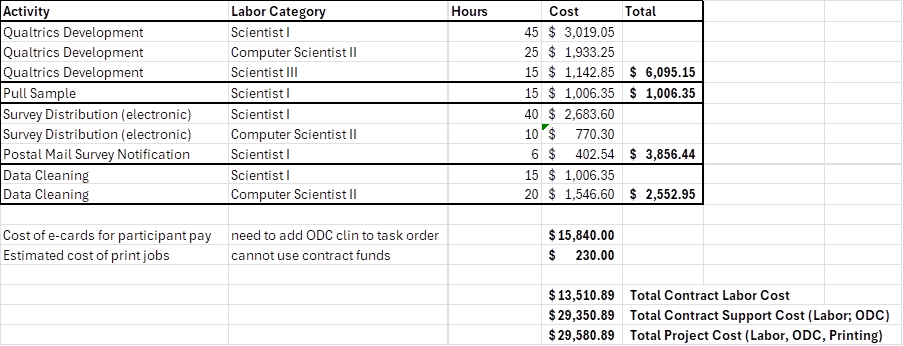
Cost obtained from Cherokee Federal Solutions, LLC on July 16, 2025 via email between Cherokee Federal Solutions, LLC program manager and FAA Contract Officer Representatives.
Toal estimates of annualized costs to the Federal government = $ 51,430.28
Explain the reasons for any program changes or adjustments.
This
is a new collection.
For collections of information whose results will be published, outline plans for tabulation and publication. Address any complex analytical techniques that will be used. Provide the time schedule for the entire project, including beginning and ending dates of the collection of information, completion of report, publication dates, and other actions.
Survey results will be made available approximately 6 months after data collection is complete.
Results will be disseminated through several publication channels including:
The OAM technical report series
Presentations at scientific meetings
Publication in scientific journals
Data will be presented at the aggregate level.
Researchers will use Structural Equation Modeling techniques to validate a model of pilot medical disclosure decision-making.
If seeking approval to not display the expiration date for OMB approval of the information collection, explain the reasons why display would be inappropriate.
Not applicable.
Explain each exception to the topics of the certification statement identified in “Certification for Paperwork Reduction Act Submissions.”
No exceptions.
1 Source: Bureau of Labor Statistics, U.S. Department of Labor, Occupational Outlook Handbook, Airline and Commercial Pilots, at https://www.bls.gov/ooh/transportation-and-material-moving/airline-and-commercial-pilots.htm (visited July 21, 2025).
2 Source: U.S. Department of Health and Human Services, “Guidelines for Regulatory Impact Analysis” (2016), https://aspe.hhs.gov/system/files/pdf/242926/HHS_RIAGuidance.pdf. On page 30, HHS states, “As an interim default, while HHS conducts more research, analysts should assume overhead costs (including benefits) are equal to 100 percent of pretax wages….” To isolate the overhead rate, the Department subtracted the benefits rate of 69 percent from the recommended rate of 100 percent.
| File Type | application/vnd.openxmlformats-officedocument.wordprocessingml.document |
| Author | Hall, Barbara L (FAA) |
| File Modified | 0000-00-00 |
| File Created | 2026-02-06 |
© 2026 OMB.report | Privacy Policy