Equine 2026 SS Part A FINAL 20260108
Equine 2026 SS Part A FINAL 20260108.docx
Equine 2026 Study
OMB: 0579-0269
UNITED STATES DEPARTMENT OF AGRICULTURE (USDA)
SUPPORTING STATEMENT PART A for
OMB Control Number: 0579-0269
Title: Center for Epidemiology and Animal Health (CEAH),
National Animal Health Monitoring System (NAHMS)
Equine 2026 Study
Andrea Beam
Program Officer
8100 NW 15th Pl.
Gainesville, FL, 32606
Cell: (352) 414-8461
USDA, Animal and Plant Health Inspection Service (APHIS)
1400 Independence Ave
Washington DC 20250
Date Prepared: October 2025
Justification
This submission is a request for approval to reinstate an information collection by the Animal and Plant Health Inspection Service (APHIS), to support the National Animal Health Monitoring System (NAHMS)’s Equine 2026 Study. APHIS is requesting the Office of Management and Budget (OMB) to approve this request for 3 years.
The NAHMS Equine 2026 Study, hereafter referred to as the Study, will consist of two phases. Phase I will consist of a questionnaire to collect information on equine health and management on farms. U.S. operations located within the 50 States with 5 or more equids1 and that meet the USDA National Agricultural Statistics Service (NASS) Agricultural Census definition for a farm or ranch2 will be eligible to be selected to participate. In Phase I, NASS enumerators will contact approximately 3,600 eligible equine operation owners and offer the opportunity to participate in the Study.
Phase II (APHIS Phase) will collect information on equine management and biosecurity at equine events3 in 30 States4. Events studied will represent many breeds, disciplines, and differing event sizes and types, but will be limited to events that are likely to draw participants from at least a large portion of a State or from out of State. Events that only draw participants from the local areas within the State where they are held will be excluded. Phase II will consist of completing a questionnaire. In addition, events may elect to participate in an on-site event facility checklist which will be conducted during the event. This on-site component of phase II will also make biological sampling for equine pathogens available to selected equine owners participating in the equine event. APHIS-NAHMS designated data collectors (e.g., Federal Veterinary Medical Officer [VMO] or other authorized personnel such as Federal Animal Health Technician [AHT], State VMO or AHT, or university cooperators) will contact a minimum of 850, but up to 2,833, equine events and offer the opportunity to participate in the Study.
This information collection will support the following objectives:
1. Describe trends in equine care, health management, and disease occurrence over time, based on data from 1998, 2005, 2015, and 2026.
2. Describe biosecurity and health management strategies related to the control of important equine infectious diseases at equine events and on farms.
3. Describe use of equine veterinary services and equine owner perceptions about availability of veterinary services for equids.
4. Describe issues surrounding equids that are at-risk (an equid that has an increased possibility of experiencing neglect, abuse or poor welfare), and/or in transition (transitioning from one home, vocation, opportunity, or owner to the next).
5. Describe owner preparedness for emergencies and natural disasters affecting equids.
6. Estimate the prevalence of equine respiratory disease pathogens from environmental samples at equine events.
Information collected through the Study will be analyzed and used to generate descriptive reports and information sheets. APHIS-NAHMS will disseminate these deliverables to equine owners, other equine industry members, academia, veterinarians, and any other interested stakeholders. The benefits to the equine industry from the Study include scientifically valid national estimates of health and management practices of the nation’s equine industry. Participation in this Study is voluntary. It is up to the individual respondent to decide whether to participate.
1. Explain the circumstances that make the collection of information necessary. Identify any legal or administrative requirements that necessitate the collection of information. Attach a copy of the appropriate section of each statute and regulation mandating or authorizing the collection of information.
The NAHMS is responsible for collecting national data on animal health and management from voluntary participants. Collection and dissemination of animal health data and information is mandated by 7 U.S.C. § 391, the Animal Industry Act of 18845, which established the precursor of APHIS Veterinary Services as well as the Bureau of Animal Industry. Legal requirements for examining and reporting on animal disease control methods were further mandated by 7 U.S.C. § 8308 of the Animal Health Protection Act, “Detection, Control, and Eradication of Diseases and Pests,” May 13, 20025.
Collection, analysis, and dissemination of livestock and poultry health information on a national basis are consistent with the APHIS mission of protecting and improving American agriculture’s productivity and competitiveness. In connection with this mission, the NAHMS program includes periodic national commodity studies to investigate animal health-related issues and examine general health and management practices used on farms. These studies are driven by industry and stakeholder interest, and information collected is not available from any other source on a national basis. Information about health and management practices on U.S. equine operations and at events is useful to the equine industry as well as many Federal and State partners.
NAHMS staff has completed a needs assessment which was a collaborative effort with equine owners, researchers, extension veterinarians, Federal and State personnel, equine veterinary practitioners and veterinary specialty clinicians, as well as other equine industry stakeholders. Over 1,500 stakeholders responded to the assessment of needs, and information gathered was used to determine the study objectives.
2. Indicate how, by whom, and for what purpose the information is to be used. Except for a new collection, indicate the actual use the agency has made of the information received from the current collection.
This collection is a reinstatement, with change, of a previously approved collection for which approval has expired. Data collected, analyzed, and interpreted will be disseminated to a wide variety of stakeholders6. Equine owners and farm managers will use the information to compare their operation’s animal health and management practices with other operations regionally and nationally. Equine affiliated groups and veterinarians will use information derived from analyses to improve preventive health measures and information outreach efforts. Pharmaceutical and biologics companies will use the information to plan and develop research and marketing strategies for their products. Equine extension specialists and extension veterinarians will use the information to identify diseases and disease trends. State and Federal officials, responsible for regulatory veterinary medicine, will use the information to make scientifically based decisions, and inform program planning and research priorities. Public health officials will use the information to estimate the magnitude of health conditions which could affect public health. Research scientists will use the information to define current and future animal health issues and direct research programming. Veterinary and agricultural students will use these data to determine the occurrence, potential risk factors, and cost of animal disease as a foundation for training in health management, animal welfare, nutrition, and environmental impacts. The benefit to the industry from the Equine 2026 study is scientifically valid national estimates of health and management practices of the nation’s equine industry and an understanding of challenges faced by equine owners/managers.
APHIS will use the data collected to:
Serve stakeholders by estimating trends in national and regional equine health, management, and movement;
Predict or detect national and regional trends in disease emergence and movement;
Address emerging issues;
Provide factual information on emergency and natural disaster preparedness, veterinary service availability, and issues relevant to equine welfare;
Provide estimates of both outcome (disease or other parameters) and exposure (risks and components) variables that can be used in analytic studies in the future by APHIS;
Provide input into the design of surveillance systems for specific diseases;
Provide parameters for animal disease spread models;
Inform future NAHMS equine studies;
Develop trade strategies and support trade decisions.
Data from previous NAHMS equine studies have been used by the agency in accordance with the statements made above. NAHMS Equine 2015 was the last in-depth study of the U.S. equine industry and focused on farms with 5 or more equids in the top 28 equine States. The 28-State target population represented 71.6 percent of all equids on farms with 5 or more equids and 70.9 percent of farms with 5 or more equids in the United States (NASS 2012 Census of Agriculture). The study updated baseline health and management information for the equine industry and provided detailed information on vaccine use, parasite control, tick control and tick-borne diseases. It provided prevalence of owner-reported equine lameness and lameness management practices, as well as costs of equine health care and outcomes of biosecurity assessments. The prevalence of Salmonella detected in equine fecal samples and the prevalence of equine tick infestations were also reported. Equine 2005 and Equine ’98 were NAHMS’ first two studies of equine health and management. These provided participants, industry, and animal health officials with baseline information on the nation’s equine population, which was informative for education, service, and research.
The NAHMS Equine 2026 study will be the fourth opportunity to provide national estimates on U.S. equine health and management. It is designed to update national estimates on equine health, management, and equine care, fill information gaps on biosecurity, and provide information on current infectious disease issues, equine welfare, and preparedness for emergencies and natural disasters.
Equine 2026 Study Data Collection Forms
Phase I (NASS Phase)
General Equine Health and Management Questionnaire (GEHMQ) - will be administered by NASS enumerators to consenting equine operations with 5 or more equids in all 50 U.S. States. This questionnaire will have four options for completion: Mail, online, telephone call, or in-person by a NASS enumerator. Questionnaires will therefore be completed by paper-assisted self-interview (PASI), computer-assisted self-interview (CASI), computer-assisted telephone interview (CATI), or computer-assisted personal interview (CAPI) modes. For the PASI or CASI, the survey will be self-administered by the equine operation respondent. For the CATI and CAPI, a NASS enumerator will contact and attempt to administer the survey to any equine operations that did not complete either the PASI or CASI. For the CATI and CAPI, NASS data collectors can also contact equine operations by e-mail or text. This questionnaire will be used to collect data on equine inventory, general management practices, and equine disease occurrence. A unique NAHMS identification number is assigned to each operation. NASS will enter and validate data collected. The complete dataset will be securely transferred to NAHMS in Fort Collins, Colorado, and stored in a secure, controlled-access data lab and data enclave. Upon completion, NASS will scan paper questionnaires (without owner contact information) and will securely transfer these to NAHMS in Fort Collins, Colorado, for data validation. NASS will also retain any questionnaires completed on paper to facilitate validation and until NAHMS indicates to NASS that they may destroy paper copies. APHIS-NAHMS will store copies of questionnaires in a secure, controlled-access data lab in Fort Collins, Colorado.
The GEHMQ Equine Product Reference Card: This is a reference card of equine vaccines and dewormers to help respondents complete questions regarding vaccinations and dewormers used on the operation.
Supporting documents for Phase I include the following:
Presurvey Letter: This letter will be mailed to selected operations, informing them that they were selected for the study and providing information about the study and next steps.
Survey Letter: This letter will inform the respondents about the questionnaire and will provide options to complete it by mail, web, phone, or in-person.
Study Information Materials: This will include a Study Launch Sheet that will promote the Equine 2026 study to respondents and an Informational Flyer for this phase of the study. It describes the study objectives and the benefits of participation. It will also include the Equine Owner/Operation Education Packet. The educational materials in this packet are comprised of a few informational sheets that will be of interest to equine operations and cover different topics that are relevant to the study.
Reminder Postcard: This postcard is to remind respondents to respond to the invitation to participate in the study by completing the questionnaire.
Thank you Note to Respondents: This is a thank you card sent to respondents who completed the questionnaire. It often contains an infographic of study results and a link to NAHMS website for additional study products.
Phase II (APHIS Phase)
Event Questionnaire - will be administered to the equine event representative by an APHIS-NAHMS designated data collector or will be completed by the event representative using a self-administered mode (e.g., computer-assisted self-administered interview or paper format). The data from the questionnaires will primarily be collected electronically, with a paper-based collection as a secondary format. Electronic data will be uploaded to a secure data enclave and/or physical data lab. Upon completion, the APHIS-NAHMS designated data collector will securely transfer any questionnaires completed on paper (without event contact information such as name or address) to NAHMS in Fort Collins, Colorado for data entry and validation. Completed paper questionnaires will be retained by the APHIS-NAHMS designated data collector to facilitate validation and until NAHMS indicates to the APHIS-designated data collector that copies may be destroyed. APHIS-NAHMS will store the dataset and copies of questionnaires in a secure, controlled-access data lab in Fort Collins, Colorado.
Event Representative Informed Consent—will be presented to the equine event representative by an APHIS-NAHMS designated data collector. This form will provide information regarding the study focus, highlight confidentiality safeguards, and explain participation for Phase II of the Study. This form will be collected electronically or on paper. One copy of this agreement will be provided to the participant (paper or email copy), and one copy will be retained by the APHIS-NAHMS designated data collector. The APHIS-NAHMS designated data collector will scan paper copies of the consent and transfer them electronically to APHIS-NAHMS over a secure cloud-based service. APHIS-NAHMS will notify the APHIS-NAHMS designated data collector when paper copies may be destroyed. APHIS-NAHMS will store all copies it receives in a secure, controlled-access data lab in Fort Collins, Colorado.
Owner/Trainer/Agent Informed Consent - will be presented to the participant by an APHIS-NAHMS designated data collector. This form will provide the equine owner, manager, trainer, or agent with information regarding the study focus, highlight confidentiality safeguards, and explain participation for Phase II of the Study. This form will be collected electronically or on paper. One copy of this agreement will be provided to the participant, and one copy will be retained by the APHIS-NAHMS designated data collector. The APHIS-NAHMS designated data collector will scan paper copies of the consent and transfer them electronically to APHIS-NAHMS over a secure cloud-based service. APHIS-NAHMS will notify the APHIS-NAHMS designated data collector when paper copies may be destroyed. APHIS-NAHMS will store all copies it receives in a secure, controlled-access data lab in Fort Collins, Colorado.
Event Facility Checklist - will be used by the APHIS-NAHMS designated data collector to record information on the event facility. Collection records may be collected electronically or with a paper-based mode depending on the preference of the APHIS-NAHMS designated data collector. Collection records that are completed using a paper-based format will be entered into an electronic database and transferred to NAHMS over a secure APHIS server. Electronic scans of the paper forms will be transferred to NAHMS over a secure cloud-based service as a backup record. Any completed paper forms will be retained by the APHIS-NAHMS designated data collector to facilitate validation and until NAHMS indicates to the data collector that the paper copies may be destroyed. APHIS-NAHMS will store the dataset and all copies it receives in a secure, controlled-access data lab in Fort Collins, Colorado.
Event Study Fecal Sample Collection Record - will be used by the APHIS-NAHMS designated data collector to record information on individual fecal samples taken from equids and composite fecal samples taken from piles of equine feces to be tested for the presence of Salmonella and equine coronavirus. Collection records will be paper-based records that will be entered into an electronic database and transferred to NAHMS over a secure APHIS server. Electronic scans of the paper forms will be transferred to NAHMS over a secure cloud-based service as a backup record. Samples will be sent to a qualified laboratory (e.g., NVSL, University of Georgia) for testing. Bacterial isolates obtained with Salmonella culture will be shipped to NVSL for serotyping and characterization of antimicrobial susceptibility patterns. Test results will be returned to NAHMS over a secure cloud-based service. Any completed paper forms will be retained by the APHIS-NAHMS designated data collector to facilitate validation and until NAHMS indicates to the data collector that paper copies may be destroyed. APHIS-NAHMS will store all copies it receives in a secure, controlled-access data lab in Fort Collins, Colorado.
Event Study Respiratory Pathogens Collection Record - will be used by the APHIS-NAHMS designated data collector to record information on samples of the external nares and lips of individual equids and corresponding environmental stall samples for individual equids as well as common areas frequently used by equids. Samples will be tested for the presence of EHV-1, EHV-4, Equine Influenza, Equine Rhinitis A and B, Streptococcus equi zooepidemicus and Streptococcus equi equi. Collection records will be paper-based records that will be entered into an electronic database and transferred to NAHMS over a secure APHIS server. Electronic scans of paper forms will be transferred to NAHMS over a secure APHIS server as a backup record. Samples will be sent to a qualified laboratory (e.g., NVSL, University of California-Davis) for testing. Test results will be returned to NAHMS over a secure APHIS server. Any completed paper forms will be retained by the APHIS-NAHMS designated data collector to facilitate validation and until NAHMS indicates to the data collector that the paper copies may be destroyed. APHIS-NAHMS will store all copies it receives in a secure, controlled-access data lab in Fort Collins, Colorado.
Event Study Feedback Survey – will be used by the event representative respondent to provide an evaluation of phase II of the NAHMS Equine 2026 study. This short questionnaire will be completed via a computer-assisted self-administered mode. The data will be collected electronically and uploaded to a secure data enclave. The APHIS-NAHMS designated data collector that conducts the event site visit will provide a postcard with a QR code on it that will link to this electronic questionnaire. NAHMS will send the survey link through mail, text, or e-mail to events that complete the Event Questionnaire, but elect to not participate in a site visit.
Event Study Data Collection by State Partners – data collection for the Event Questionnaire, Event Study Fecal Collection Record, Event Study Respiratory Pathogens Collection Record, and the Event Facility Checklist is expected to include the following APHIS-NAHMS designated data collectors: Field APHIS-Veterinary Services Veterinary Medical Officers (VMOs) and Animal Health Technicians (AHTs), State VMOs/AHTs, and university personnel.
Supporting documents for Phase II include the following:
Event Survey Letter: This letter will inform the respondents about the survey and provide options to complete the survey by mail, web, or phone.
Study Information Materials: This will include the Event Phase Informational Flyer that promotes the event study and the Equine Event Education Packet. The educational materials in this packet are comprised of a few informational sheets that will be of interest to equine events and will cover different topics that are relevant to the study.
Reminder Postcard for Hard-to-Reach Events: This postcard is to remind respondents to respond to the survey. This postcard may be sent by mail, e-mail, or text message.
Thank You Card/Site Visit Summary: This is a thank you card that will be left at events that participate in the event on-site visit facility checklist and data collection to say thank you for participating.
Event Contact Scripts: Text and phone messages as well as phone scripts for inviting equine events to participate in the NAHMS Equine 2026 Event Study.
After Action Field Survey: Optional survey for APHIS data collectors so that we can improve future NAHMS studies.
Event Training Manual: Manual that provides supplemental context and details to assist APHIS data collectors in administering the event questionnaire, event facility checklist, and the biologics collection.
Thank You Card - APHIS data collectors: NAHMS will send a thank you note to APHIS data collectors and field staff who participate in data collection.
Screenshots of the Equine Event Questionnaire and Facility Checklist: Show data collection instruments for events within an electronic survey platform (Qualtrics).
Example of Infographic Results: Example - NAHMS Goat 2019 Study (Phase I NASS Phase Infographic), USDA-APHIS, Example of infographics https://www.aphis.usda.gov/sites/default/files/goat2019-infographic-overview.pdf.
3. Describe whether, and to what extent, the collection of information involves the use of automated, electronic, mechanical, or other technological collection techniques or other forms of information technology, e.g., permitting electronic submission of responses, and the basis for the decision for adopting this means of collection. Also describe any consideration of using information technology to reduce burden.
APHIS makes every effort to comply with E-Government Act, 2002 (E-Gov) and to provide for alternative submission of information collections.
Electronic technologies will be used to help promote and administer the Equine 2026 study. Equine owners, equine event representatives, and others affiliated with the equine industry will learn about the Equine 2026 study via paper mailings, APHIS–NAHMS email messages, association membership groups, notices published in hard copy magazines, web sites, trade magazine emails, and other agricultural publications.
It is expected that 75 percent of responses to both phases will be made using an electronic data collection system, including the use of computer-assisted self-interviews, computer-assisted telephone interviews, and computer-assisted personal interviews. These modes of data collection are being used to expand access to the study survey for people who need or prefer electronic or telephone options for participating in the study. Providing these modes will reduce burden for study respondents who would have difficulty or limited time for completing and mailing back a paper survey.
4. Describe efforts to identify duplication. Show specifically why any similar information already available cannot be used or modified for use for the purpose(s) described in Item 2 above.
The information that APHIS collects is not available from any other source, and every effort has been made to avoid duplication.
Literature searches for existing data relevant to the Equine 2026 study have been performed. Available data were reviewed and compiled from all known sources. Sources reviewed include cooperative State research, private industry and professional publications, diagnostic laboratories, other Federal and State agencies, the American Association of Equine Practitioners (AAEP), the American Horse Council, and universities such as University of Georgia and University of California-Davis. Personnel from Federal agencies and academia were consulted in their area of expertise to identify areas of potential duplication. No other entity/source is collecting and analyzing this type of information on equine health and management of equids on a national and regional scale for the U.S. equine industry.
5. If the collection of information impacts small businesses or other small entities, describe the methods used to minimize burden.
The definition of “small entities” from the OMB Form 83-I instructions is as follows: a small entity may be (1) a small business which is deemed to be one that is independently owned and operated and that is not dominant in its field of operation; (2) a small organization that is any not-for-profit enterprise that is independently owned and operated and is not dominant in its field; or (3) a small government jurisdiction which is a government of a city, county, town, township, school district, or special district with a population of less than 50,000.
Phase I of the study involves equine farms. The smallest category of farm with equine inventory in the NASS 2022 Census of Agriculture is a farm with 1 to 24 equines. Farms of this size comprise 96.6 percent of all farms with horse and pony inventory and 92.4 percent of all farms with mule, burro, and donkey inventory. Farms of this size also account for 74.3 percent of combined inventory for all equines, which includes the inventory for horse and pony stock and the inventory for mules, burros, and donkeys. Phase II of the study will be administered by APHIS and will focus on equine events that are State, regional, or national in scope (drawing participants from an entire State, multiple adjacent States or multiple non-adjacent States, respectively). This approach should reduce impacts on smaller entities holding equine events at the local level in which participants are drawn from small geographical areas and governmental jurisdictions.
It is estimated that 95 percent of the 3,600 equine operations in Phase I would be considered small entities using the NASS information above and the information from the NAHMS Equine 2015 Study. Also, it is estimated that approximately 25 percent of the 2,833 equine events in Phase II would be considered small entities from a calculation of the share of events from the NAHMS Equine 2005 study that had a State scope (rather than regional or national). Therefore, it is expected that approximately 64 percent of the subjects across both phases of the Study would be considered small entities.
This survey is designed to collect the minimum amount of data required from a minimum number of owners and the minimum number of equine events to ensure statistically and scientifically valid data. Sample size calculations computed for important outcomes of interest account for major strata and expected response rates to help ensure the sampling effort is sufficient to produce estimates with 95 percent confidence without undue burden on respondents. Tailoring the information that is requested on the questionnaires and building skip and routing logic to request specific information only from the subsets of the respondent group from which the information is needed helps to optimize time respondents spend providing data. Effort is also made to ensure data collection tools are clear, concise, and function appropriately. Questionnaires will go through a pretesting process to assure optimal survey quality prior to initiation of data collection. Input was solicited from the equine industry to ensure that the information that will be collected is relevant and timely. Respondents will be able to complete the questionnaire using a mode that they prefer and at a time when it is most convenient for them, which will minimize potential impacts on respondents regardless of the size of their operation. It is also important to highlight that this is a voluntary study; it is at the discretion of the individual owner or individual event to decide whether or not it is desirable for them to participate.
6. Describe the consequence to Federal program or policy activities if the collection is not conducted or is conducted less frequently, as well as any technical or legal obstacles to reducing burden.
This is a voluntary one-time data collection. Eleven years have passed since the last NAHMS Equine study, and a new look at equine health and management practices is needed. The type and quality of data collected by NAHMS through national on-farm and equine event collections is unique; no other entity is collecting this type of information in the United States.
Without this type of national data, the United States’ ability to detect trends in management and health status, either directly or indirectly, would be reduced or nonexistent. The possibility of assessing the reduction of risk to human health from zoonotic diseases due to management changes based on NAHMS data would also be nonexistent. Furthermore, the ability to respond to international trade issues involving the health status and management practices of the U.S. equine population would be severely reduced, potentially impacting the global marketability of animals and products. Disease spread models would not have the necessary parameters to more accurately predict the spread of an outbreak.
7. Explain any special circumstances that require the collection to be conducted in a manner inconsistent with the general information collection guidelines in 5 CFR 1320.5
requiring respondents to report information to the agency more often than quarterly;
requiring respondents to prepare a written response to a collection of information in fewer than 30 days after receipt of it;
requiring respondents to submit more than an original and two copies of any document;
requiring respondents to retain records, other than health, medical, government contract, grant-in-aid, or tax records for more than 3 years;
in connection with a statistical survey, that is not designed to produce valid and reliable results that can be generalized to the universe of study;
requiring the use of a statistical data classification that has not been reviewed and approved by OMB;
that includes a pledge of confidentiality that is not supported by authority established in statute or regulation, that is not supported by disclosure and data security policies that are consistent with the pledge, or which unnecessarily impedes sharing of data with other agencies for compatible confidential use; or
requiring respondents to submit proprietary trade secret, or other confidential information unless the agency can demonstrate that it has instituted procedures to protect the information's confidentiality to the extent permitted by law.
No special circumstances exist that would require this collection to be conducted in a manner inconsistent with the general information collection guidelines in 5 CFR 1320.5.
8. Describe efforts to consult with persons outside the agency to obtain their views on the availability of data, frequency of collection, the clarity of instructions and recordkeeping, disclosure, or reporting form, and on the data elements to be recorded, disclosed, or reported. If applicable, provide a copy and identify the date and page number of publication in the Federal Register of the agency’s notice, soliciting comments on the information collection prior to submission to OMB.
We regularly consult with individuals regarding study objectives, goals, and plans. Our experts contributed to needs assessments by providing questions relevant to equine health and management. Using their current research in animal disease management, they helped to recommend and provide feedback on numerous survey questions that are beneficial to stakeholders. These experts also encourage participation and help promote the Study at national conferences and contribute to promotional materials.
The following people were consulted during the planning and coordination of the Study:
Dr. Katie Flynn
Senior Staff Veterinarian, Equine Health and Biosecurity
United States Equestrian Federation
859-225-6991
kflynn@usef.org
Dr. Margo Macpherson
Professor Emeritus, College of Veterinary Medicine, University of Florida
352-258-6394
macphersonm@ufl.edu
Dr. Brandy Burgess
Associate Professor of Epidemiology & Infection Control
College of Veterinary Medicine, University of Georgia
706-542-3598
The following professional organizations were informed of the Equine 2026 study objectives and provided an opportunity to provide comments:
Coalition of State Horse Councils leadership and members
Members of the American Horse Council Health and Regulatory Committee
American Horse Council President
American Association of Equine Practitioners Infectious Diseases Committee Chairperson
USDA NASS reviewed this information collection request package. As a result of their review NASS recommended NAHMS reduce the time interval to the next survey. NASS provided recommendations for the General Equine Health and Management Questionnaire (GEHMQ) and these changes were incorporated.
APHIS announced in the Federal Register on Monday, February 24, 2025 (Vol. 90, Number 35 Pages 10471 - 10472) a 60-day public comment notice for this information collection request. One comment was received that expressed full support for this study and recommended no substantive changes to the information collection request. We acknowledge the comment and appreciate their interest in these studies.
9. Explain any decision to provide any payment or gift to respondents, other than remuneration of contractors or grantees.
APHIS will provide no direct payments or gifts to respondents.
Communication back to Phase I respondents will include a thank you card sent by NASS to those who complete the questionnaire. This will potentially include information to let them know that aggregate survey results are available.
Communication back to Phase II respondents will include a thank you card that the APHIS -NAHMS designated data collector will leave with the event after conducting the site visit. Additionally, if the budget permits, each respondent that completes a Phase II site visit will receive a sign featuring equine biosecurity practices. This sign can be posted at their event to help communicate to equine owners and the event-attending public the importance of good biosecurity to protect equine health. The value of each sign is approximately $25.00. Alternatively, events that elect to participate in the site visit may receive thermometers (number to be determined and budget permitting) that the event can offer to equine owners/trainers/agents to encourage them to monitor their equid’s rectal temperature during the event. In addition, if budget permits, respondents who complete a Phase II site visit will be given a small token, such as a USDA water bottle sticker, clipboard, or pen valued at less than $5.
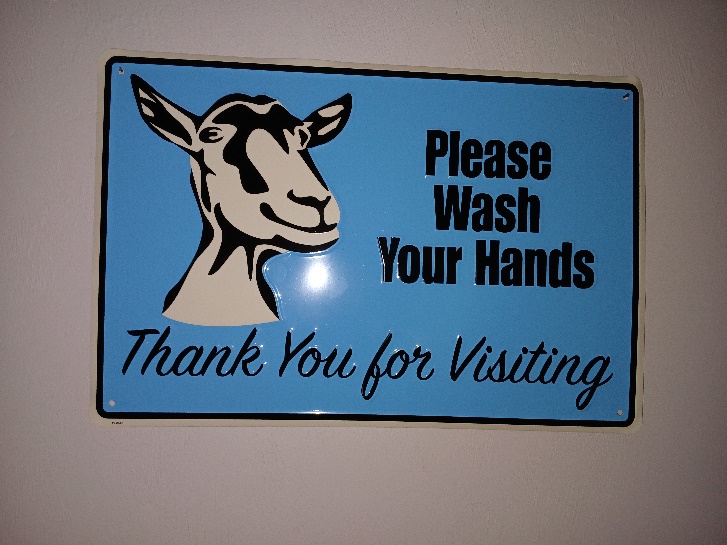
An example of the type of biosecurity signage provided in a previous NAHMS study (NAHMS Goat 2019) is shown in Figure 1. Respondents that completed the NAHMS Goat 2019 Agritourism questionnaire (NAHMS-455) received the sign for their business to promote proper hygiene for their clients interacting with their animals.
Figure 1. NAHMS Goats 2019 Agritourism Sign
10. Describe any assurance of confidentiality provided to respondents and the basis for the assurance in statute, regulation, or agency policy.
Phase I (NASS Phase) and the questionnaire component of Phase II (APHIS Phase, not including the facility checklist, nor the biological sampling) of the Study will be collected under the Confidential Information Protection and Statistical Efficiency Act (CIPSEA). Only the NASS data collector collecting data will have knowledge of the Phase I participant’s identity, connected with questionnaire information. APHIS will have both the Phase II event contact identity and questionnaire information, but a unique respondent identification number for each event will prevent direct connection of the two. All forms, data, and reports will refer to the respondent by a numeric code, which is assigned by NASS or NAHMS. NAHMS will destroy the link between participant and numeric code once data collection, entry, validation, and report dissemination are complete. NAHMS will not link survey information with participant name or contact information. All completed survey forms received by NAHMS will be stored in a secure, controlled-access data lab in Fort Collins, Colorado.
The biological sample collection and event facility checklist portion of Phase II (APHIS Phase) will not be protected under CIPSEA. Respondent information will be protected by ensuring that no identifying information is linked to the data after entry into a dataset. Personally identifiable information (PII) for the equine event representative is not linked to biologic sample collection form responses or results and is destroyed after biologic testing is complete. No personal identifiable information will be collected for the animal or the animal’s owner during the biological sample collection. Samples sent to cooperating labs will only have a unique participant ID. Only summary estimates based upon the inference population will be reported. All forms and datasets held by APHIS will refer to the respondent by a unique numeric code, which is assigned by NAHMS. While every effort will be made to ensure respondent confidentiality, it is possible that information could be released as required by a Freedom of Information Act request, or in the case of required disease reporting. However, since names, addresses, and personal information will not be collected on forms, no connection can be made between a completed questionnaire or laboratory results and the respondent.
Every NASS and APHIS-NAHMS designated data collector that may handle a questionnaire, or data coming from a completed questionnaire, is required to sign a form governing certification and restrictions on use of unpublished data. Furthermore, once data are published, individuals are limited to the use of aggregate data files. Access to individual data files is restricted to maintain respondent confidentiality.
Additionally, NASS has statutory protection that allows them to keep respondent’s farm or operation data, such as owner or producer name and address information, confidential. Several U.S. Codes apply to data collected by NASS:
Title 7, Section 2276 - Confidentiality of Information.
Title 18, Section 1902 - Disclosure of Crop Information and Speculation Thereon.
Title 18, Section 1905 - Disclosure of Confidential Information Generally.
There are also additional protections available through CIPSEA:
Title V of E-Government Act of 2002, Public Law 107-347, Section 513. Fines and Penalties.
Title V of E-Government Act of 2002, Public Law 107-347, Section 512. Limitations on Use and Disclosure of Data and Information.
11. Provide additional justification for any questions of a sensitive nature, such as sexual behavior and attitudes, religious beliefs, and other matters that are commonly considered private. This justification should include the reasons why the agency considers the questions necessary, the specific uses to be made of the information, the explanation to be given to persons from whom the information is requested, and any steps to be taken to obtain their consent.
There are no questions of a sensitive or personal nature used in this collection activity.
12. Provide estimates of the hour burden of the collection of information.
Indicate the number of respondents, frequency of response, annual hour burden, and an explanation of how the burden was estimated. If this request for approval covers more than one form, provide separate hour burden estimates for each form and aggregate the hour burdens in item 13 of OMB form 83-I.
A total of 10,225 burden hours are needed to complete the Equine 2026 study information collection activity, of which 6,263 hours are expected for equine owners and event representatives and 3,962 hours are expected for State partner data collection assistance. A detailed burden estimate has been included on the enclosed APHIS 71 Form.
Provide estimates of annualized cost to respondents for the hour burdens for collections of information, identifying and using the correct wage rate categories.
The total cost for equine owners and event representatives and for State partner data collection is $ 806,019.19 ($417,086.83 + $388,932.36)..
Estimated respondent costs for equine owners and event representatives are calculated based on a mean estimate of $46.75 per hour and a multiplicative factor of 1.4245 for benefits costs. The respondent cost for equine owners and event representatives is $417,086.83 (6,263 hours x $46.75 x 1.4245).
The wage estimate was obtained from the April 2, 2025, Occupational Employment and Wages report from the Bureau of Labor Statistics (https://www.bls.gov/news.release/pdf/ocwage.pdf) for farmers, ranchers, and other agricultural representatives (Table 1).
According to DOL BLS news release USDL-25-3-1358, September 12, 2025 (https://www.bls.gov/news.release/pdf/ecec.pdf), benefits account for 29.8 percent of employee costs for private industry workers, and wages account for the remaining 70.2 percent. Mathematically, total costs can be calculated as a function of wages using a multiplier of 1.4245.
Estimated respondent costs for State partner data collection is based on an estimate of $67.44 per hour and a multiplicative factor of 1.4556 for benefits costs. The respondent cost for State partners is $411,256.38 (3,962 hours x $65.53 x 1.6234).
The wage estimate was obtained from the April 2, 2025, Occupational Employment and Wages report from the Bureau of Labor Statistics for veterinarians (Table 1).
According to DOL BLS news release USDL-25-1358, benefits account for 31.3 percent of employee costs for civilian workers, and wages account for the remaining 68.7 percent. Mathematically, total costs can be calculated as a function of wages using a multiplier of 1.4556.
13. Provide estimates of the total annual cost burden to respondents or recordkeepers resulting from the collection of information. (Do not include the cost of any hour burden in items 12 and 14). The cost estimates should be split into two components: (a) a total capital and start-up cost component (annualized over its expected useful life); and (b) a total operation and maintenance and purchase of services component.
There are no capital/start-up costs or ongoing operations and maintenance costs for respondents or recordkeepers associated with this information collection.
14. Provide estimates of annualized cost to the Federal government. Provide a description of the method used to estimate cost and any other expense that would not have been incurred without this collection of information.
The estimated cost to the Federal Government is $2,643,612.53. For more specific information, please see the APHIS 79 Form.
15. Explain the reasons for any program changes or adjustments reported in items 13 or 14 of the OMB Form 83-I.
This is a reinstatement request for information collection 0579-0269. This information collection request is to examine health and management practices of equids and investigate current issues. It involves an estimated 6,545 respondents, 29,390 responses, and 10,225 hours of burden.
The 60-day FRN reported the following: 6,545 respondents, 16,832 responses, and 7,466 hours of burden.
This was based on the way responses and burden were reported historically for NAHMS studies, and not with respect to separate mailings. We have adjusted the way it is reported for the 30-day FRN by separating out responses, nonresponses, and burden hours according to each of the mailings. This method counts each mailing as a response. Additional burden time was also added for the study educational materials, the reminder postcard for events, and for increased use of State partners for data collection.
16. For collections of information whose results are planned to be published, outline plans for tabulation and publication.
Information from this survey will be summarized immediately following the collection, editing, and validation of the data. Data will be entered into a database management system, and statistical calculations will be performed, e.g., descriptive statistics including frequency distribution, prevalence, and point estimates. Variance measures and confidence intervals for the point estimates will be calculated in order to describe the precision of the descriptive statistics generated. SAS survey procedures or SUDAAN software from Research Triangle Institute (RTI International) will be used to correctly calculate the standard error to account for the complex study design. Standard errors will be published along with the point estimates.
Considerable effort has been placed on reducing the time between the end of data collection and release of a final publication. Electronic information in the form of dashboards, visual reports, and/or PDF reports from the study will be made available to equine owners, equine operation owners, equine event representatives, other equine industry affiliated members, academia, researchers, extension agents, veterinarians, animal health related industries, Federal agencies, legislators, and any other interested party. Copies of current and past information from the NAHMS are available on the NAHMS website: https://www.aphis.usda.gov/nahms.
17. If seeking approval to not display the expiration date for OMB approval of the information collection, explain the reasons that display would be inappropriate.
The OMB approval expiration date will be displayed on the electronic and paper surveys and read over the phone. APHIS is not seeking approval to not display the expiration date for OMB approval on the forms used in this collection.
18. Explain each exception to the certification statement identified in the “Certification for Paperwork Reduction Act.”
APHIS is able to certify compliance with all provisions in the Paperwork Reduction Act.
1 Equids include horses, ponies, mules, burros, and donkeys.
2 USDA NASS Census of Agriculture Methodology. Accessed September 17, 2022.http://www.agcensus.usda.gov/Publications/2012/Full_Report/Volume_1,_Chapter_1_US/usappxa.pdf
3 Equine events include but are not limited to the following event types: Western performance events, rodeo, polo match, fair or exhibition, race, trail ride (recreational) or endurance, sale, auction, breed or discipline inspection, training clinic, draft-horse pull/shows, horse trials, dressage, 3-day eventing, hunter paces, and driving competitions.
4 The States selected for inclusion in Phase II (APHIS phase) of the Equine 2026 study are: Arizona, California, Colorado, Connecticut, Florida, Georgia, Hawaii, Illinois, Kentucky, Massachusetts, Maryland, Minnesota, Missouri, Mississippi, North Carolina, Nebraska, New Jersey, New York, Ohio, Oklahoma, Oregon, Pennsylvania, South Carolina, Texas, Utah, Virginia, Vermont, Washington, Wisconsin, and Wyoming.
5 7 United States Code § 391, and 7 U.S.C. § 8308.
6 A complete list of publications using NAHMS Equine data is available on the web at http://www.aphis.usda.gov/nahms/.
| File Type | application/vnd.openxmlformats-officedocument.wordprocessingml.document |
| Author | Beam, Andrea - MRP-APHIS |
| File Modified | 0000-00-00 |
| File Created | 2026-01-13 |
© 2026 OMB.report | Privacy Policy