Teen
[NCBDDD] Documenting Outcomes Associated with Persistent Tic Disorders (Including Tourette Syndrome) in Children, Adolescents, and Young Adults Through Surveillance
Att 5_Teen Forms
Teen Form
OMB:
Form Approved OMB
NO. 0920-24EG Exp.
Date XX/XX/20XX
Attachment 5: Teen Self Report (ages 12-17 years) Table of Contents
Age, School Discipline
Patient Health Questionnaire – modified for adolescents (PHQ-A) and self-harm
Suicide
Healthcare Transition
Screen for Child Anxiety Related Disorders (SCARED)
Clinical Assessment
Ask Suicide Screening Questions (ASQ)
Yale Global Tic Severity Scale (YGTSS)
Public reporting burden of this collection of information is estimated to average 45 minutes, including the time for reviewing instructions, searching existing data sources, gathering and maintaining the data needed, and completing and reviewing the collection of information. An agency may not conduct or sponsor, and a person is not required to respond to a collection of information unless it displays a currently valid OMB control number. Send comments regarding this burden estimate or any other aspect of this collection of information, including suggestions for reducing this burden to CDC/ATSDR Reports Clearance Officer; 1600 Clifton Road NE, MS H21-8, Atlanta, Georgia 30333; ATTN: PRA (0920-24EG).
Questions from national surveys and previously validated measures were prioritized for inclusion in the Tic Information Collection System (TICS).
Question sources for the teen self-report survey include the following instruments:
National Health Interview Survey -Teen (NHIS-Teen) (https://www.cdc.gov/nchs/nhis/teen/index.html)
National Survey on Drug Use and Health (NSDUH) https://www.samhsa.gov/data/data-we- collect/nsduh-national-survey-drug-use-and-health
Youth Risk Behavior Survey https://www.cdc.gov/yrbs/media/pdf/2023/2023_YRBS_Standard_HS_Questionnaire.pdf
The survey will include two validated measures:
Patient Health Questionnaire (PHQ-A; PHQ-9 modified for adolescents)
Screen for Child Anxiety Related Disorders (SCARED)
Additionally, there will be a 2-part clinical assessment (this is included in the burden calculation):
Ask Suicide Screening Questions (ASQ)
Yale Global Tic Severity Scale (YGTSS)
We were mindful of the benefits of using previously tested and/or approved questions for adoption in our survey. All above surveys and instruments underwent extensive pilot and field testing and/or were previously approved and fully implemented in previous studies. Moreover, many of the questions we used are from surveys of nationally representative samples of US children and adults. This holds an added benefit of allowing us to compare our data on tic disorders to external prevalence rates for health indicators in the general U.S. population. In compiling questions into a single survey, we made only minor revisions to some of these existing questions, primarily related to this being a REDCap survey vs. a stand-alone form. For example, in our survey, we revised the instructions in the SCARED from “fill in one circle” to “select the response”. We also added healthcare transition questions specific to tic disorders.
We have noted where each survey question originated (in the “Taken From” column). We have also annotated whether modifications were made using yellow highlight. New questions and answers are highlighted in blue.
Age, School Discipline, Self-injury
-
Section Intro
Taken From
This survey asks about mental health and emotional well-being. If you answer that you have had suicidal thoughts or behaviors, or purposely tried to hurt yourself, we may tell your parent/guardian and/or your doctor or other clinic staff. This would be to ensure your safety and provide you with support and care.

By completing this survey, you accept and consent to this protocol. If you have concerns or need immediate help, please tell the clinic staff.
Completing the survey is voluntary. If you are not comfortable answering a question, just leave it blank.
Revised from a previous project.
-
Question
Response Options
Taken From
How old are you, in years?
Free text (numerical)
Asking to make sure they are using the correct form. Will receive a message to contact project staff if not
between 12-17.
Please answer the following questions about yourself.
-
Question
Response Options
Taken From
During the past 12 months, have you been unfairly disciplined at school?
Yes
No
YRBS
PHQ-A
-
Proposed Question
Response options
Taken From
How often have you been bothered by each of the following symptoms during the past two weeks?
Feeling down, depressed, irritable, or hopeless?
Not at all
Several days
More than half the days
PHQ-A
-
Nearly every day
Little interest or pleasure in
doing things?
Not at all
Several days
More than half the days
Nearly every day
PHQ-A
Trouble falling asleep, staying asleep, or sleeping too much?
Not at all
Several days
More than half the days
Nearly every day
PHQ-A
Poor appetite, weight loss,
or overeating?
Not at all
Several days
More than half the days
Nearly every day
PHQ-A
Feeling tired, or having little energy?
Not at all
Several days
More than half the days
Nearly every day
PHQ-A
Feeling bad about yourself - or feeling that you are a failure, or that you have let yourself or your family
down?
Not at all
Several days
More than half the days
Nearly every day
PHQ-A
Trouble concentrating on things like school work, reading, or watching TV?
Not at all
Several days
More than half the days
Nearly every day
PHQ-A
Moving or speaking so slowly that other people could have
noticed?
Or the opposite — being so fidgety or restless that you were moving around a lot more than usual?
Not at all
Several days
More than half the days
Nearly every day
PHQ-A
Thoughts that you would be better off dead, or of hurting yourself in some way?
Not at all
Several days
More than half the days
Nearly every day
PHQ-A
In the past year have you felt depressed or sad most days, even if
you felt okay sometimes?
Yes
No
PHQ-A
If you are experiencing any of these
problems
onthisform, howNot difficult at all
Somewhat difficult
PHQ-A
-
difficult have these problems made it for you to do your work, take care of things at home, or get along with
other people?
Very difficult
Extremely difficult
During the past 12 months, how many times did you do something to purposely hurt yourself without wanting to die, such as cutting or burning yourself on purpose?
0 times
1 time
2 or 3 times
4 or 5 times
6 or more times
YRBS
[Program staff will receive an alert if this item is endorsed]
Suicide
-
The next few questions are about thoughts of suicide. You can answer “I’m not sure” or “I don’t want to answer” to any question.
NSDUH YSUINT, YSUI01
At any time in the past 12 months, up to and including today, did you seriously think about trying to kill yourself?
Yes
No
I’m not sure
I don’t want to
NSDUH YSUINT, YSUI01
[Program staff will receive an alert if this item is
answer
endorsed]
During the past 12 months, did you make any
plans to kill yourself?
Yes
No
I’m not sure
I don’t want to
NSDUH YSUI02
[Program staff will receive an alert if this item is
answer
endorsed]
During the past 12 months, did you try to kill
yourself?
Yes
No
I’m not sure
I don’t want to
NSDUH YSUI03
[Program staff will receive an alert if this item is
answer
endorsed]
[IF YSUI03=Yes] During the past 12 months, did you get medical attention from a doctor or other health professional as a result of an attempt to kill yourself?
Yes
No
I’m not sure
I don’t want to
NSDUH YSUI04
[Program staff will receive an alert if this item is
answer
endorsed]
-
[IF YSUI04=Yes] Did you stay in a hospital overnight or longer because you tried to kill yourself?
Yes
No
I’m not sure
I don’t want to
answer
NSDUH YSUI05
[Program staff will receive an alert if this item is endorsed]
If you ever feel that you need to talk to someone about mental health struggles, emotional distress, alcohol or drug use concerns, you can call or text the 988 Suicide and Crisis Lifeline by dialing/texting 988. Counselors are available to talk at any time of the day or night and they can give you information about services in your area.
Services are available in English and Spanish.
Please write down these numbers and website address.
988 (call or text)
Adapted from NSDUH
AHELP
In NSDUH, this information was originally only offered if YSUI01, YSUI02 or
YSUI03=1, but we will provide for all.
[If the respondent skipped any questions in this section, they will receive the following message:] You skipped one or more questions on this page. Please review and complete the question(s) before going to the next page. If you intentionally skipped the question(s), you can go to the next page.
Healthcare Transition (from Pediatric to Adult Health Care)
-
Proposed Question
Response options
Taken From
1. Not including dental care, about how long has it been since you last saw a doctor or other health professional about your health?
Within the past 12
months
A year ago or more, but less than 2 years ago
2 or more years ago
Never [skip to next
section (demographics)]
2023 NHIS Teen
[LASTDR]
2. At this LAST medical care visit, did you have a chance to speak with a doctor or other health professional privately, without a
parent or guardian in the room?
Yes
No
2023 NHIS Teen
[TIMEALONE]
3. Was this a wellness visit, physical, or general purpose check- up?
This kind of visit typically includes: height and weight measurements, vaccinations, and vision or hearing checks. The doctor or other health professional may also discuss topics related to your health such as growth and development, diet and exercise, safety, and sleep patterns. These visits are usually scheduled in advance and occur when you are not sick. If a wellness exam was combined with a sick care visit, include this visit. An obstetrician/gynecologist (OB/GYN) may perform this
visit.
Yes [skip to Q6 if Q1=1;
skip to Q8 if Q1=2,3]
No
2023 NHIS Teen
[WELLNESS]
4. About how long has it been since you last saw a doctor or other health professional for a wellness visit, physical, or general purpose check-up?
This kind of visit typically includes: height and weight measurements, vaccinations, and vision or hearing checks. The doctor or other health professional may also discuss topics related to your health such as growth and development, diet and exercise, safety, and sleep patterns. These visits are usually scheduled in advance and occur when you are not sick. If a wellness exam was combined with a sick care visit, include this visit. An obstetrician/gynecologist (OB/GYN) may perform this
visit.
Within the past 12
months
A year ago or more, but
less than 2 years ago
2 or more years ago
Never [skip to Q6 if Q1=1; Q8 if Q1=2,3]
2023 NHIS Teen
[WELLVIS]
5. At this LAST wellness visit, physical, or general purpose check- up, did you have a chance to speak with a doctor or other health professional privately, without a parent or guardian in the room?
Yes
No
[for either answer, skip to Q8 if Q4=2,3,4 and Q1=2,3]
2023 NHIS Teen
[PTIMEALONE]
-
6. During the past 12 months, has a doctor or other health professional talked to you about understanding the changes in health care that happen at age 18?
This can include understanding changes in privacy, consent,
access to information, or decision making.
Yes
No
2023 NHIS Teen
[NEWCHANGES]
7. During the past 12 months, has a doctor or other health professional talked to you about gaining skills to manage your
health and health care?
Yes
No
2023 NHIS Teen
[GAINSKILLS]
8. Have you ever had a visit with a doctor or other health
professional that your parents or guardians didn’t know about?
Yes
No
2023 NHIS Teen
[OTHERVISIT]
Do you have concerns about transitioning from pediatric to adult
healthcare providers for care related to your tic disorder?
Yes
No
New question
(If yes) What are your main concerns?
Open ended (limit = 125 words)
New Question
[If the respondent skipped any questions in this section, they will receive the following message:]
You skipped one or more questions on this page. Please review and complete the question(s) before going to the next page. If you intentionally skipped the question(s), you can go to the next page.
Screen for Child Anxiety Related Disorders (SCARED)
-
Proposed Question
Response options
Taken
From
Below is a list of sentences that describe how people feel. Read each phrase and decide if it is “Not True or Hardly Ever True” or “Somewhat True or Sometimes True” or “Very True or Often True” for you. Then for each sentence,
fill in one circle that corresponds toselect the response that seems todescribe you for the last 3 months.
SCARED
When I feel frightened, it is hard to breathe.
Not true or hardly ever true
Somewhat true or sometimes true
Very true or often true
SCARED
I get headaches when I am at school.
Not true or hardly ever true
Somewhat true or sometimes true
Very true or often true
SCARED
I don’t like to be with people I don’t know well.
Not true or hardly ever true
Somewhat true or sometimes true
Very true or often true
SCARED
I get scared if I sleep away from home.
Not true or hardly ever true
Somewhat true or sometimes true
Very true or often true
SCARED
I worry about other people liking me.
Not true or hardly ever true
Somewhat true or sometimes true
Very true or often true
SCARED
When I get frightened, I feel like passing out.
Not true or hardly ever true
Somewhat true or sometimes true
Very true or often true
SCARED
-
I am nervous.
Not true or hardly ever true
Somewhat true or sometimes true
Very true or often true
SCARED
I follow my mother or father wherever they go.
Not true or hardly ever true
Somewhat true or sometimes true
Very true or often true
SCARED
People tell me that I look nervous.
Not true or hardly ever true
Somewhat true or sometimes true
Very true or often true
SCARED
I feel nervous with people I don’t know well.
Not true or hardly ever true
Somewhat true or sometimes true
Very true or often true
SCARED
I get stomachaches at school.
Not true or hardly ever true
Somewhat true or sometimes true
Very true or often true
SCARED
When I get frightened, I feel like I am going crazy.
Not true or hardly ever true
Somewhat true or sometimes true
Very true or often true
SCARED
I worry about sleeping alone.
Not true or hardly ever true
Somewhat true or sometimes true
Very true or often true
SCARED
I worry about being as good as other kids.
Not true or hardly ever true
Somewhat true or sometimes true
Very true or often true
SCARED
When I get frightened, I feel like things are not real.
Not true or hardly ever true
Somewhat true or sometimes true
Very true or often true
SCARED
I have nightmares about something bad happening to my
parents.
Not true or hardly ever true
Somewhat true or sometimes true
Very true or often true
SCARED
I worry about going to school.
Not true or hardly ever true
Somewhat true or sometimes true
Very true or often true
SCARED
When I get frightened, my heart beats fast.
Not true or hardly ever true
Somewhat true or sometimes true
Very true or often true
SCARED
I get shaky.
Not true or hardly ever true
Somewhat true or sometimes true
Very true or often true
SCARED
I have nightmares about something bad happening to
me.
Not true or hardly ever true
Somewhat true or sometimes true
Very true or often true
SCARED
I worry about things working out for me.
Not true or hardly ever true
SCARED
-
Somewhat true or sometimes true
Very true or often true
When I get frightened, I sweat a lot.
Not true or hardly ever true
Somewhat true or sometimes true
Very true or often true
SCARED
I am a worrier.
Not true or hardly ever true
Somewhat true or sometimes true
Very true or often true
SCARED
I get really frightened for no reason at all.
Not true or hardly ever true
Somewhat true or sometimes true
Very true or often true
SCARED
I am afraid to be alone in the house.
Not true or hardly ever true
Somewhat true or sometimes true
Very true or often true
SCARED
It is hard for me to talk with people I don’t know well.
Not true or hardly ever true
Somewhat true or sometimes true
Very true or often true
SCARED
When I get frightened, I feel like I am choking.
Not true or hardly ever true
Somewhat true or sometimes true
Very true or often true
SCARED
People tell me that I worry too much.
Not true or hardly ever true
Somewhat true or sometimes true
Very true or often true
SCARED
I don’t like to be away from my family.
Not true or hardly ever true
Somewhat true or sometimes true
Very true or often true
SCARED
I am afraid of having anxiety (or panic) attacks.
Not true or hardly ever true
Somewhat true or sometimes true
Very true or often true
SCARED
I worry that something bad might happen to my parents.
Not true or hardly ever true
Somewhat true or sometimes true
Very true or often true
SCARED
I feel shy with people I don’t know well.
Not true or hardly ever true
Somewhat true or sometimes true
Very true or often true
SCARED
I worry about what is going to happen in the future.
Not true or hardly ever true
Somewhat true or sometimes true
Very true or often true
SCARED
When I get frightened, I feel like throwing up.
Not true or hardly ever true
Somewhat true or sometimes true
Very true or often true
SCARED
I worry about how well I do things.
Not true or hardly ever true
Somewhat true or sometimes true
Very true or often true
SCARED
-
I am scared to go to school.
Not true or hardly ever true
Somewhat true or sometimes true
Very true or often true
SCARED
I worry about things that have already happened.
Not true or hardly ever true
Somewhat true or sometimes true
Very true or often true
SCARED
When I get frightened, I feel dizzy.
Not true or hardly ever true
Somewhat true or sometimes true
Very true or often true
SCARED
I feel nervous when I am with other children or adults and I have to do something while they watch me (for example: read aloud, speak, play a game, play a sport.)
Not true or hardly ever true
Somewhat true or sometimes true
Very true or often true
SCARED
I feel nervous when I am going to parties, dances, or any place where there will be people that I don’t know well.
Not true or hardly ever true
Somewhat true or sometimes true
Very true or often true
SCARED
I am shy.
Not true or hardly ever true
Somewhat true or sometimes true
Very true or often true
SCARED
Which of the following best represents how you think of yourself?
Gay (lesbian or gay)
Straight, this is not gay (or lesbian or gay)
Bisexual
Something else
I don’t know the answer
HHS/OMB
approved method to ask SO questions.
Did anyone help you complete this survey?
Yes, someone helped me, but I completed most of the survey on my own.
Yes, someone helped me with all or
most of the survey.
No, I completed the survey on my own.
New
[If the respondent skipped any questions in this section, they will receive the following message:]
You skipped one or more questions on this page. Please review and complete the question(s) before going to the next page. If you intentionally skipped the question(s), you can go to the next page.
Clinical Assessments (attached)
Ask Suicide Screening Questions (ASQ)
Yale Global Tic Severity Scale (YGTSS)
The following questions will be asked by a trained professional, not as part of the survey.
a. Ask Suicide Screening Questions (ASQ) (these are in a separate REDCap form since they are not part of the self-report survey; these questions will be asked by a healthcare provider or trained program staff member to individuals with tic disorders aged 9-26 years with possible input from parent for children 9-17 years.
-
Question
Response Options
Taken From
Note to person administering the ASQ: Please provide the following information to the respondent before asking the questions.
This survey asks about mental health and emotional well-being. If you answer that you have had suicidal thoughts or behaviors, or purposely tried to hurt yourself, we may inform your doctor or other clinic staff. This would be to ensure your safety and provide you with support and care.
By completing this survey, you accept and consent to this protocol. If you have concerns or need immediate help, please tell the clinic staff.
1) In the past few weeks, have you wished you were dead?
Yes
No
Refused to answer
ASQ
2) In the past few weeks, have you felt that you or your family would be better off if you were dead?
Yes
No
Refused to answer
ASQ
3) In the past week, have you been having thoughts about killing yourself?
Yes
No
Refused to answer
ASQ
4) Have you ever tried to kill yourself?
Yes
No
Refused to answer
ASQ
[If yes to 4,]
4a) How? 4b) When?
Free text
ASQ
The patient answered "No" to questions 1 through 4; therefore, screening is complete, and it is not necessary to ask question #5. No intervention is necessary; however, clinical judgment can always override a negative screen.
Do you want to ask the patient question #5 (Are you having thoughts of killing yourself right now?) or finish the ASQ?
Ask question #5
Finish the ASQ
Incorporated from ASQ instructions, within skip pattern. ASQ instructions included
below.
[If “Yes” or “Refused” to any of the above (Q1-Q4)] This patient is considered a positive screen. Ask question #5 to assess acuity.
5) Are you having thoughts of killing yourself right now?
Yes
No
ASQ
-
[If yes to Q5]
5b) Please describe:
Open ended
ASQ
[If yes to Q5]
Patient is acute positive screen (imminent risk identified)
Patient requires a STAT safety/full mental health evaluation. Patient cannot leave until evaluated for safety.
Keep patient in sight. Remove all dangerous objects from room. Alert physician or clinician responsible for patient's care.
Provide resources to all patients: 988 Suicide and Crisis Lifeline, 988 (call, text), https://988lifeline.org/ (and relevant local information)
[If no to Q5]
Patient is non-acute positive screen (potential risk identified).
Patient requires a brief suicide safety assessment to determine if a full mental health evaluation is needed. If a patient (or parent/guardian) refuses the brief assessment, this should be treated as an "against medical advice" (AMA) discharge.
Alert physician or clinician responsible for patient's care.
Provide resources to all patients: 988 Suicide and Crisis Lifeline, 988 (call, text), https://988lifeline.org/
Initials of person (staff/professional) completing ASQ
Open ended
Overview of ASQ - this information is included above, within skip logic, and only included here for reference.
If patient answers "No" to all questions 1 through 4, screening is complete (not necessary to ask question #5). No intervention is necessary (*Note: Clinical judgment can always override a negative screen).
If patient answers "Yes" to any of questions 1 through 4, or refuses to answer, they are considered a positive screen. Ask question #5 to assess acuity.
"Yes" to question #5 = acute positive screen (imminent risk identified)
Patient requires a STAT safety/full mental health evaluation. Patient cannot leave until evaluated for safety.
Keep patient in sight. Remove all dangerous objects from room. Alert physician or clinician responsible for patient's care.
"No" to question #5 (but “Yes” or “Refused” to one of questions 1-4) = non-acute positive screen (potential risk identified)
Patient requires a brief suicide safety assessment to determine if a full mental health
evaluation is needed. If a patient (or parent/guardian) refuses the brief assessment, this should
ASQ

ID #:
Y G T S S
Yale Global Tic Severity Scale
Yale Child Study Center
October 1992 version
1

MOTOR TIC SYMPTOM CHECKLIST
 Description
of Motor
Tic
Symptoms.
Motor
tics usually
begin
in childhood and are characterized by sudden
jerks
or movements, such
as
forceful
eye
blinking or a rapid head jerk to one side or the other. The
same
tics
seem
to
recur
in
bouts
during
the
day
and
are
worse
during
periods
of
fatigue
and/or
stress. Many
tics
occur without warning and may
not
even
be
noticed by
the
person
doing
them. Others are preceded by
a
subtle urge that is difficult to describe (some liken
it
to the urge to scratch
an
itch).
In many
cases
it
is
possible
to voluntarily
hold
back the tics
for
brief
periods
of
time.
Although
any
part
of the
body
may
be
affected,
the
face,
head,
neck,
and
shoulders
are
the
most
common
areas
involved.
Over
periods of
weeks
to months, motor tics wax and wane and old tics may
be
replaced by
totally
new
ones.
Description
of Motor
Tic
Symptoms.
Motor
tics usually
begin
in childhood and are characterized by sudden
jerks
or movements, such
as
forceful
eye
blinking or a rapid head jerk to one side or the other. The
same
tics
seem
to
recur
in
bouts
during
the
day
and
are
worse
during
periods
of
fatigue
and/or
stress. Many
tics
occur without warning and may
not
even
be
noticed by
the
person
doing
them. Others are preceded by
a
subtle urge that is difficult to describe (some liken
it
to the urge to scratch
an
itch).
In many
cases
it
is
possible
to voluntarily
hold
back the tics
for
brief
periods
of
time.
Although
any
part
of the
body
may
be
affected,
the
face,
head,
neck,
and
shoulders
are
the
most
common
areas
involved.
Over
periods of
weeks
to months, motor tics wax and wane and old tics may
be
replaced by
totally
new
ones.
Simple motor tics can be described as a sudden, brief, "meaningless" movement that recurs in bouts (such as excessive eye blinking or squinting). Complex motor tics are sudden, stereotyped (i.e., always done in the same manner) semi-purposeful (i.e., the movement may resemble a meaningful act, but is usually involuntary and not related to what is occurring at the time) movements that involve more than one muscle group. There may often be a constellation of movements such as facial grimacing together with body movements. Some complex tics may be misunderstood by other people (i.e., as if you were shrugging to say "I don't know"). Complex tics can be difficult to distinguish from compulsions; however, it is unusual to see complex tics in the absence of simple ones. Often there is a tendency to explain away the tics with elaborate explanations (e.g., “I have hay fever that has persisted” even though it is not the right time of year). Tics are usually at their worst in childhood and may virtually disappear by early adulthood, so if you are completing this form for yourself, it may be helpful to talk to your parents, an older sibling, or a relative, as you answer the following questions.
Age of first motor tics? years old
Describe first motor tic:
Was tic onset sudden or gradual?
Age of worst motor tics? years old

Motor Tic Symptom Checklist
In the boxes on the left below, please check with a mark (x) the tics the patient
has EVER experienced
is CURRENTLY experiencing (during the past week) State AGE OF ONSET (in years) if patient has had that behavior.
Also, in the tic descriptions below, please circle or underline the specific tics that the patient has experienced (circle or underline the words that apply).
2
[In Years]
Ever |
Cur- rent |
Age of onset |
The patient has experienced, or others have noticed, involuntary and apparently purposeless bouts of: |
Ver |
-eye movements.
|
|
|
eye blinking, squinting, a quick turning of the eyes, rolling of the eyes to one side, or opening eyes wide very briefly. |
|
|
|
|
eye gestures such as looking surprised or quizzical, or looking to one side for a brief period of time, as if s/he heard a noise. |
|
-nose, mouth, tongue movements, or facial grimacing.
|
|
|
nose twitching, biting the tongue, chewing on the lip or licking the lip, lip pouting, teeth baring, or teeth grinding. |
|
|
|
|
broadening the nostrils as if smelling something, smiling, or other gestures involving the mouth, holding funny expressions, or sticking out the tongue. |
|
-head jerks/movements.
|
|
|
touching the shoulder with the chin or lifting the chin up. |
|
|
|
|
throwing the head back, as if to get hair out of the eyes. |
|
-shoulder jerks/movements.
|
|
|
jerking a shoulder. |
|
|
|
|
shrugging the shoulder as if to say "I don't know." |
|
quickly
flexing
the
arms
or
extending
them,
nail
biting,
poking
with fingers,
or
popping
knuckles.
passing
hand through the hair in a combing like fashion, or touching
objects
or
others,
pinching, or
counting
with
fingers
for
no
purpose, or writing tics, such as writing over and over the same letter
or
word,
or
pulling
back
on
the
pencil
while
writing.

-leg, foot or toe movements.
|
|
|
kicking, skipping, knee-bending, flexing or extension of the ankles; shaking, stomping or tapping the foot. |
|
|
|
|
taking a step forward and two steps backward, squatting, or deep knee-bending. |
|
3
Ever |
Cur- rent |
Age of onset |
The patient has experienced, or others have noticed, involuntary and apparently purposeless bouts of: |
Ver |
-abdominal/trunk/pelvis movements.
|
|
|
tensing the abdomen, tensing the buttocks. |
|
-other simple motor tics.
|
|
|
Please write example(s): |
|
|
-other complex motor tics.
|
|
|
touching |
|
|
|
|
tapping |
|
|
|
|
picking |
|
|
|
|
evening-up |
|
|
|
|
reckless behaviors |
|
|
|
|
stimulus-dependent tics (a tic which follows, for example, hearing a particular word or phrase, seeing a specific object, smelling a particular odor). Please write example(s): |
|
|
|
|
rude/obscene gestures; obscene finger/hand gestures. |
|
|
|
|
unusual postures. |
|
|
|
|
bending or gyrating, such as bending over. |
|
|
|
|
rotating or spinning on one foot. |
|
|
|
|
copying the action of another (echopraxia) |
|
|
|
|
sudden tic-like impulsive behaviors. Please describe: |
|
|
|
|
tic-like behaviors that could injure/mutilate others. Please describe: |
|
|
|
|
self-injurious tic-like behavior(s). Please describe: |
|
-other involuntary and apparently purposeless motor tics (that do not fit in any previous categories).
|
|
|
Please describe any other patterns or sequences of motor tic behaviors: |
|
4
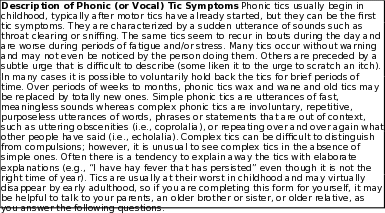
Phonic
(Vocal)
Tics
Age of first vocal tics? years old.
Describe first vocal tic:
Was tic onset sudden or gradual?
Age of worst vocal tics? years old.
5
Phonic Tic Symptom Checklist
In the boxes on the left below, please check with a mark (x) the tics the patient
has EVER experienced
is CURRENTLY experiencing (during the past week) State AGE OF ONSET (in years) if patient has had that behavior.
Also, in the tic descriptions below, please circle or underline the specific tics that the patient has experienced (circle or underline the words that apply).
[In Years]
-
Ever
Cur- rent
Age of
onset
The patient has experienced, or others have noticed, bouts of involuntary and apparently purposeless utterance of:
Ver
-coughing.
-throat clearing.
-sniffing.
-whistling.
-animal or bird noises.
-Other simple phonic tics. Please list:
-syllables. Please list:
-words. Please list:
-rude or obscene words or phrases. Please list:
-repeating what someone else said, either sounds, single words or
sentences. Perhaps repeating what’s said on TV (echolalia).
-repeating something the patient said over and over again
(palilalia).
-other tic-like speech problems, such as sudden changes in volume or pitch. Please describe:
Describe any other patterns or sequences of phonic tic behaviors:
6

NUMBER
Motor
Phonic
None
o
o
Single
tic
o
o
Multiple
discrete
tics
(2-5)
o
o
Multiple
discrete
tics
(>5)
o
o
Multiple
discrete
tics
plus
as
least
one
orchestrated
pattern
of
multiple
simultaneous
or
sequential
tics
where
it
is
difficult
to
distinguish
discrete
tics
o
o
Multiple
discrete
tics
plus
several
(>2)
orchestrated
paroxysms
of
multiple
simultaneous
or
sequential
tics
that
where
it
is
difficult
to
distinguish
discrete
tics
o
o
SEVERITY RATINGS
NUMBER
Motor
Phonic
None
o
o
Single tic
o
o
Multiple discrete tics (2-5)
o
o
Multiple discrete tics (>5)
o
o
Multiple discrete tics plus as least one orchestrated pattern of multiple simultaneous or
sequential tics where it is difficult to distinguish discrete tics
o
o
Multiple discrete tics plus several (>2) orchestrated paroxysms of multiple simultaneous
or sequential tics that where it is difficult to distinguish discrete tics
o
o
0
1
2
3
4
5
FREQUENCY
Motor
Phonic
NONE
No
evidence
of
specific
tic
behaviors
o
o
RARELY
Specific
tic behaviors have been present during previous week.
These
behaviors occur infrequently, often not on a daily basis.
If
bouts of tics occur, they are brief and uncommon.
o
o
OCCASIONALLY
Specific
tic behaviors are usually present on a daily basis, but there
are
long tic-free intervals during the day.
Bouts
of tics may occur on occasion and are not sustained for more than
a few minutes at a time.
o
o
FREQUENTLY
Specific
tic behaviors are present on a daily basis.
tic
free intervals as long as 3 hours are not uncommon.
Bouts
of tics occur regularly but may be limited to a single setting.
o
o
ALMOST
ALWAYS
Specific
tic behaviors are present virtually every waking hour of every
day, and periods of sustained tic behaviors occur regularly.
Bouts
of tics are common and are not limited to a single setting.
o
o
ALWAYS
Specific
tic behaviors are present virtually all the time.
Tic
free intervals are difficult to identify and do not last more
than 5 to 10 minutes at most.
o
o 
1
2
3
4
5
INTENSITY
Motor
Phonic
ABSENT
o
o
MINIMAL
INTENSITY
Tics
not visible or audible (based solely on patient's private
experience) or tics are less forceful than comparable voluntary
actions and are typically not noticed because of their intensity.
o
o
MILD
INTENSITY
Tics
are not more forceful than comparable voluntary actions or
utterances and are typically not noticed because of their
intensity.
o
o
MODERATE
INTENSITY
Tics
are more forceful than comparable voluntary actions but are not
outside the range of normal expression for comparable voluntary
actions or utterances.
They
may call attention to the individual because of their forceful
character.
o
o
MARKED
INTENSITY
Tics
are more forceful than comparable voluntary actions or utterances
and typically have an "exaggerated" character.
Such
tics frequently call attention
to
the
individual because of
their
forceful
and
exaggerated
character.
o
o
SEVERE
INTENSITY
Tics
are extremely forceful and exaggerated in expression.
These
tics call attention to the individual and may result in risk of
physical injury (accidental, provoked,
or
self-inflicted)
because
of
their
forceful
expression.
o
o
1
2
3
4
5
7
COMPLEXITY
Motor
Phonic
NONE
If
present,
all
tics
are
clearly
"simple"
(sudden,
brief,
purposeless)
in
character.
o
o
BORDERLINE
Some
tics
are
not
clearly
"simple"
in
character.
o
o
MILD
Some
tics are clearly "complex" (purposive in appearance)
and mimic brief "automatic" behaviors, such as
grooming, syllables, or brief meaningful utterances such as
"ah
huh,"
"hi"
that
could
be
readily
camouflaged.
o
o
MODERATE
Some
tics are more "complex" (more purposive and sustained
in appearance) and may occur in orchestrated bouts that would be
difficult to camouflage but could be rationalized or "explained"
as normal behavior or speech (picking, tapping, saying
"you
bet"
or
"honey",
brief
echolalia).
o
o
MARKED
Some
tics are very "complex" in character and tend to occur
in sustained orchestrated bouts that would be difficult to
camouflage and could not be easily rationalized
as
normal
behavior
or
speech
because
of
their
duration
and/or
their
unusual, inappropriate, bizarre or obscene character (a lengthy
facial contortion, touching genitals, echolalia, speech
atypicalities, longer bouts of saying "what do you mean" repeatedly,
or
saying
"fu"
or
"sh").
o
o
SEVERE
Some
tics involve lengthy bouts of orchestrated behavior or speech
that would be impossible to camouflage or successfully
rationalize as normal because of their duration and/or extremely
unusual, inappropriate, bizarre or obscene character (lengthy displays
or
utterances
often
involving
copropraxia,
self-abusive
behavior,
or
coprolalia).
o
o 
1
2
3
4
5
INTERFERENCE
Motor
Phonic
NONE
o
o
MINIMAL
When
tics
are
present,
they
do
not
interrupt
the
flow
of
behavior
or
speech.
o
o
MILD
When
tics
are
present,
they
occasionally interrupt
the
flow
of
behavior
or
speech.
o
o
MODERATE
When
tics
are
present,
they
frequently
interrupt
the
flow
of
behavior
or speech.
o
o
MARKED
When
tics
are
present,
they
frequently interrupt
the
flow
of
behavior
or speech,
and
they
occasionally
disrupt
intended
action
or
communication.
o
o
SEVERE
When
tics
are
present,
they
frequently disrupt
intended
action
or communication.
o
o 
1
2
3
4
5
8

NONE
o
MINIMAL
Tics
associated with subtle difficulties in self-esteem, family life,
social acceptance, or school or job functioning (infrequent upset
or concern about tics vis a vis the future, periodic, slight
increase in family tensions because of tics, friends or
acquaintances may occasionally notice
or
comment
about
tics
in
an
upsetting
way).
o
MILD
Tics
associated
with
minor
difficulties
in
self-esteem,
family
life,
social
acceptance,
or
school
or
job
functioning.
o
MODERATE
Tics
associated with some clear problems in self-esteem family life,
social acceptance, or school or job functioning (episodes of
dysphoria, periodic distress and upheaval in the family, frequent
teasing by peers or episodic social avoidance, periodic
interference in school
or
job
performance
because
of
tics).
o
MARKED
Tics
associated
with
major
difficulties
in
self-esteem,
family
life,
social
acceptance,
or
school
or
job
functioning.
o
SEVERE
Tics
associated with extreme difficulties in self-esteem, family life,
social acceptance, or school or job functioning (severe
depression with suicidal ideation, disruption of the family
(separation/divorce, residential placement), disruption of social
tics - severely restricted life
because
of
social
stigma
and
social
avoidance,
removal
from
school
or
loss
of
job).
o
IMPAIRMENT
NONE
o
MINIMAL Tics associated with subtle difficulties in self-esteem, family life, social acceptance, or school or job functioning (infrequent upset or concern about tics vis a vis the future, periodic, slight increase in family tensions because of tics, friends or acquaintances may occasionally notice
or comment about tics in an upsetting way).
o
MILD Tics associated with minor difficulties in self-esteem, family life, social acceptance, or
school or job functioning.
o
MODERATE Tics associated with some clear problems in self-esteem family life, social acceptance, or school or job functioning (episodes of dysphoria, periodic distress and upheaval in the family, frequent teasing by peers or episodic social avoidance, periodic interference in school
or job performance because of tics).
o
MARKED Tics associated with major difficulties in self-esteem, family life, social acceptance, or
school or job functioning.
o
SEVERE Tics associated with extreme difficulties in self-esteem, family life, social acceptance, or school or job functioning (severe depression with suicidal ideation, disruption of the family (separation/divorce, residential placement), disruption of social tics - severely restricted life
because of social stigma and social avoidance, removal from school or loss of job).
o
0
10
20
30
40
50
SCORING
-
Number (0-5)
Frequency (0-5)
Intensity (0-5)
Complexity (0-5)
Interference (0-5)
Total (0-25)
Motor Tic Severity
Vocal Tic Severity
-
Total Tic Severity Score = Motor Tic Severity + Vocal Tic Severity (0-50)
Total Yale Global Tic Severity Scale Score (Total Tic Severity Score + Impairment) (0-100)
9
| File Type | application/vnd.openxmlformats-officedocument.wordprocessingml.document |
| Author | Bitsko, Rebecca (Becky) (CDC/NCBDDD/DHDD) |
| File Modified | 0000-00-00 |
| File Created | 2025-07-01 |
© 2026 OMB.report | Privacy Policy